What is the Legal Checklist for Setting Up a Limited Company in the UK?
What is the Legal Checklist for Setting Up a Limited Company in the UK?

There's a particular moment you will remember for your lifetime: the email from Companies House confirming your company now exists. It usually lands within a day. It feels like the finish line. It isn't. How to set up a limited company in the UK is, on paper, one of the simplest administrative tasks in British business. You can do it online very easily, for £100, and have a certificate of incorporation before your coffee's gone cold. The trouble is that registration and proper setup are two different things, and a lot of new directors don't discover the gap until something goes wrong, and then you will need a legal solicitor for the proper documentation and official work.
This checklist walks through both halves of the job: the paperwork Companies House wants and the legal groundwork that actually protects you once trading starts. Because a business partner falling out over shares, or a client refusing to pay against a contract that was never properly written, tends to cost a great deal more than the £100 you saved doing it all yourself.
What is a Limited Company?
A limited company is a legally recognised business structure where the company is treated as a distinct entity separate from its owners. This means your personal finances remain protected if the business faces debts or legal troubles.
Pros:
- Limited Liability: Your personal assets (like your house or savings) are protected if the company loses money.
- Tax Efficiency: You often pay less tax by taking a combination of salary and dividends.
- Professional Image:
Clients and investors often view limited companies as more legitimate and trustworthy.
Cons:
- More Admin: You must file annual financial reports and public records with Companies House.
- Less Privacy:
Details about directors and company finances are visible on public registers.
Decide Whether a Limited Company is Right for You
Before you touch the Companies House website, it's worth pausing on whether incorporation actually suits how you plan to operate. Plenty of sole traders convert out of habit or because someone told them it "looks more professional", without weighing up what changes underneath.
Limited Company vs Sole Trader
A limited company is a separate legal entity from the people who run it. That distinction matters more than most new directors realise at the outset.
- Separate legal identity: The company owns its assets and debts, not you personally.
- Limited liability: Your personal finances are generally protected if the business runs into trouble, beyond what you've invested.
- Different tax treatment: Corporation Tax replaces Income Tax on business profits, and dividends work differently to a sole trader's drawings.
- More admin: Annual accounts, confirmation statements and statutory filings all become part of the routine.
Sole trading is easy on paperwork but leaves your personal assets exposed if things go wrong. Limited status trades a bit more admin for a genuine legal shield, which is exactly why most people considering growth, investment or higher-risk work choose to incorporate.
Choose Between Limited by Shares or Limited by Guarantee
Most commercial businesses register as companies limited by shares. Profits belong to shareholders, ownership is divided into shares, and the structure suits anyone planning to trade for profit or bring in investors down the line.
Companies limited by guarantee are typically used for non-profits, clubs or community organisations, where there are no shareholders and any surplus is reinvested rather than distributed. If you're building a commercial venture, shares are almost certainly the route.
Decide Who Will Own and Run the Company
This is where a lot of first-time founders slow down, and rightly so.
You'll need to work out who the directors are (the people running the company day-to-day), who the shareholders are (the owners), what percentage each shareholder holds, and who counts as a Person with Significant Control, or PSC. These roles can overlap: a sole founder is often a director, shareholder and PSC all at once, but with two or more people involved, getting this wrong at the outset tends to store up problems for later.
Is It Better to Be a Sole Trader or a Limited Company in the UK?
It depends on your income level, appetite for admin, and how much personal risk you're comfortable carrying. Many freelancers stay as sole traders for years quite happily before switching once turnover and risk both increase.
Once you've settled the structure, the next job is picking a name and pulling together the basic details Companies House will ask for.
Choose Your Company Name and Prepare the Basic Details
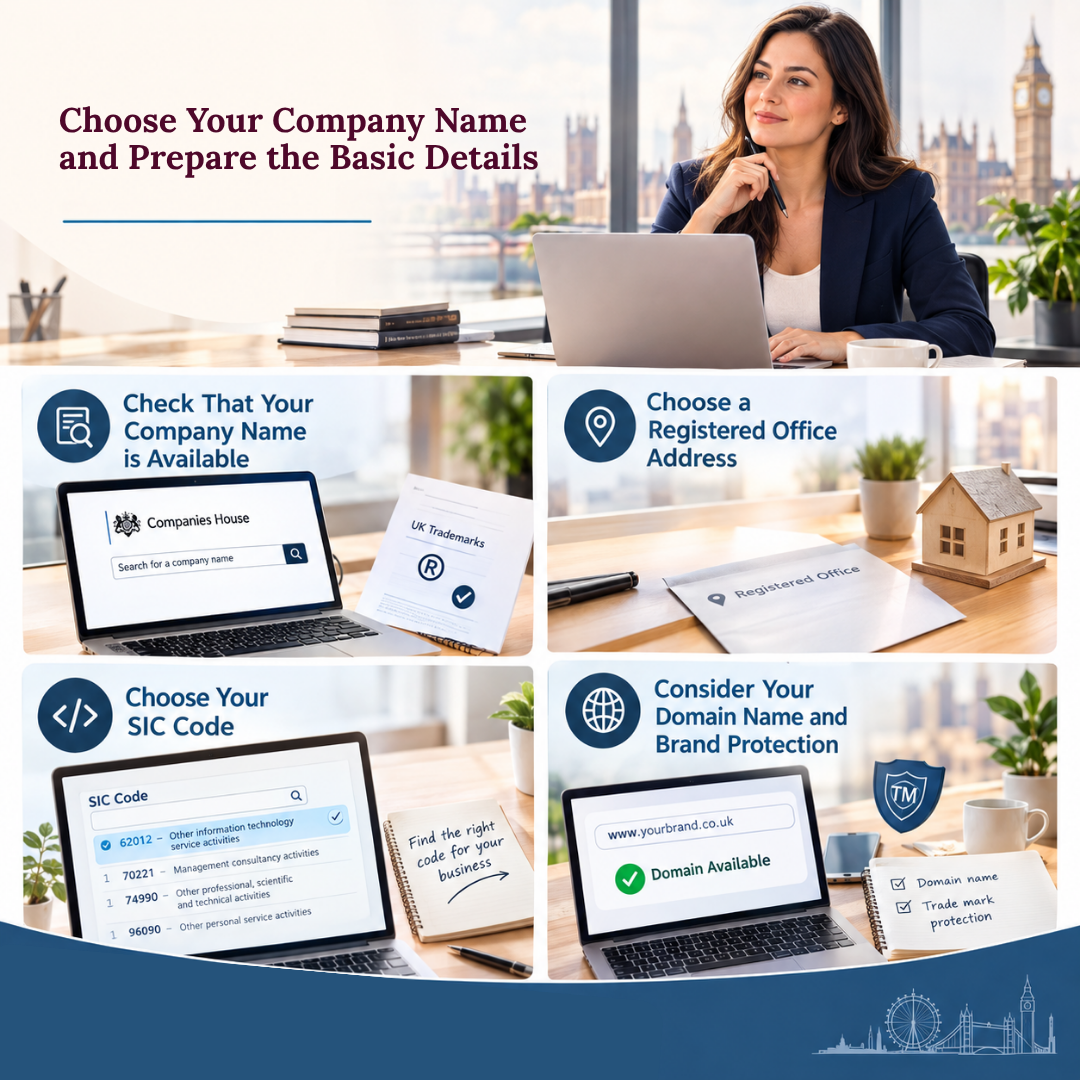
This stage feels administrative, but a few small decisions here save real hassle later, particularly around branding disputes.
Check That Your Company Name is Available
Companies House won't register a name that's identical or too similar to an existing one, and certain words need permission before you can use them. It's also worth checking the UK trademark register separately. A name can pass the Companies House check and still infringe someone else's registered trademark, which is a headache best avoided before you've printed a single business card.
Choose a Registered Office Address
Your registered office is the official address that Companies House and HMRC will use to contact you, and it appears on the public register. Many home-based founders use a registered office service instead of their home address, largely for privacy, since anyone can look this information up online.
Choose Your SIC Code
The Standard Industrial Classification code tells Companies House what your business actually does. Pick one that genuinely reflects your activities rather than the closest-sounding option — it's used for statistical purposes and, occasionally, by lenders or credit checks assessing your business.
Consider Your Domain Name and Brand Protection
Before you commit to a name, check whether the matching domain is free and think about whether trade mark protection makes sense. This step gets skipped constantly, and it's frustrating to build a brand around a name only to find the .co.uk was gone months earlier or a competitor holds the trademark.
With the basics settled, it's time to prepare the documents that actually get you registered.
Prepare the Legal Documents and Register Your Company
This is the part most guides treat as the whole story. It's genuinely one piece of a bigger picture, but it does need doing properly.
Prepare the Memorandum of Association
The memorandum is a short statement confirming the founding shareholders' agreement to form the company. If you register online, this is generated automatically as part of the process, so there's rarely much manual work involved.
Understand the Articles of Association
The articles are the company's internal rulebook: how decisions get made, how shares can be transferred, and what happens if a director wants to resign. Most companies use Companies House's standard "model articles", which work fine for a single founder or a simple two-person setup.
Where things get more complex – several shareholders, unequal voting rights, plans to bring in investors – bespoke articles drafted for your specific situation tend to serve the business far better than the generic template.
Set Out Your Share Structure
You'll need to decide the number and type of shares, who holds them, and how ownership breaks down. This gets recorded in a statement of capital at incorporation. It sounds like a formality until two co-founders realise, eighteen months in, that they never actually agreed on what happens if one of them wants out.
Identify People With Significant Control
A PSC is generally someone who holds 25% or more of the shares or voting rights, or who otherwise exercises significant control over the company. Most small companies simply list their major shareholders here. It's a legal requirement, not an optional extra.
Register With Companies House
Once everything's ready, you submit your application. Assuming there are no issues, you'll typically receive:
- Your company registration number
- A certificate of incorporation
- Automatic registration for Corporation Tax (if you register online through Companies House)
What Documents Do You Need to Set Up a Limited Company in the UK?
In practice: a memorandum of association, articles of association, details of directors and shareholders, a statement of capital, and PSC information. Online registration bundles most of this into a guided form.
Registration itself, though, is only step one of running a compliant business.
Open a Business Bank Account in Your Company Name
It's tempting to run everything through a personal account "just for now". Don't. This causes more accounting headaches than almost any other early decision.
Why Open a Business Bank Account?
Keeping company money separate from your own makes bookkeeping straightforward, presents a more credible image to clients and suppliers, and gives you a clear, auditable trail of income and expenditure — something your accountant, and potentially HMRC, will thank you for.
What Do You Need to Open the Account?
Banks generally want your company registration number, incorporation certificate, details of directors and significant shareholders, and standard identity verification for each director. Some banks now offer same-day digital onboarding; others still ask for a branch visit.
Can You Use a Personal Bank Account for a Limited Company?
Legally, a limited company's money belongs to the company, not to you as an individual, even if you're the only director. Mixing funds makes it far harder to prove what's a business expense and what isn't, and it can complicate things considerably if HMRC ever queries your accounts.
Do You Need a Business Bank Account for a Limited Company in the UK?
There's no explicit legal requirement, but in practice, it's close to unavoidable — most accountants will insist on it, and it protects the "separate legal entity" status that limited companies rely on in the first place.
Arrange the Right Business Insurance
Insurance rarely makes it onto the initial checklist, yet it's one of the first things that catches new directors out.
Check Whether Any Insurance is Legally Required
If you employ staff, employers' liability insurance is a legal requirement in almost all cases, with penalties for operating without it. Beyond insurance, taking on employees brings wider legal responsibilities around workplace safety and conduct. For example, understanding what constitutes workplace harassment evidence can help you establish clear HR policies, address grievances properly, and protect both your staff and your business from costly tribunal claims.
Consider Other Types of Business Insurance
Beyond the legal minimum, most companies benefit from public liability cover if customers visit their premises, professional indemnity if they give advice or services, and product liability if they manufacture or sell goods. Cyber insurance has become increasingly relevant as more small businesses hold customer data online.
Choose Cover Based on Your Business Risks
The right combination depends on your headcount, whether the public interacts with your premises, the type of advice or products you offer, and the sector you're in. A one-person consultancy and a five-person manufacturing outfit need entirely different policies.
What Insurance Does a Limited Company Need in the UK?
At minimum, employers' liability if you have staff. Beyond that, it depends on your risk profile — public liability, professional indemnity and product liability are the most common additions.
Put the Essential Legal and Business Protections in Place
Registration gives you a company. It doesn't give you contracts, protected branding, or clarity over who owns what. That's the next job.
Draft Business Terms and Contracts
Every business needs clear terms and conditions covering payment timelines, late-payment provisions, and what happens if a client cancels or a supplier fails to deliver. Verbal agreements or a handful of emails rarely hold up when a dispute actually lands.
Protect Your Intellectual Property
This covers your business name and any trade marks, copyright in materials you create, product designs, and — often overlooked — who actually owns work produced by employees or freelance contractors. Without a written agreement, ownership of that work isn't always as obvious as founders assume.
Check Licences and Industry-specific Requirements
Some sectors need specific licences or regulatory approval before trading legally — food businesses, financial services and construction all have their own rules. It's worth checking what applies to your industry and, where relevant, your local authority.
Once these protections are in place, attention shifts to keeping the company compliant year after year.
Understand Your Ongoing Legal and Tax Responsibilities
Companies House registration is the beginning of the relationship, not the end of it. Directors carry ongoing duties that don't disappear once the certificate arrives.
Understand Corporation Tax Responsibilities
You'll need to register with HMRC for corporation tax, keep accurate financial records, and file returns within the required deadlines. Missing these isn't a minor slip — penalties build up quickly.
Keep Company and Accounting Records
Directors are expected to maintain company records, financial records, shareholder details, and copies of important contracts and resolutions — typically for at least six years. Prioritising sound legal document organisation from day one ensures you can easily produce statutory records during an HMRC enquiry, satisfy investor due diligence, or resolve disputes without delay.
File Annual Accounts and Confirmation Statements
Annual accounts show the company's financial position; the confirmation statement checks that Companies House holds accurate, up-to-date information about your company. Both are ongoing legal requirements, not one-off tasks.
Understand Your Responsibilities as a Director
Directors have statutory duties to act in the company's best interests, avoid conflicts of interest, keep proper records, and follow the rules set out in the articles. These duties carry personal weight — they're not just box-ticking.
Why Do You Need a Solicitor When Setting Up a Limited Company?

You don't need a solicitor to register a company. Plenty of single-founder businesses manage perfectly well without one. Where legal advice earns its keep is in preventing the expensive problems that tend to surface once the business is actually running.
Get the Company Structure Right From the Start
Share ownership, director responsibilities, and decision-making rules all become far harder to unpick once the company's trading. A legal solicitor can help you set these out properly from day one, including bespoke articles where the standard template doesn't fit.
Put Shareholder Agreements in Place
If you're starting a company with someone else, a shareholder agreement is arguably the single most valuable document you can commission. It sets out what happens if a shareholder wants to leave, how shares get valued and transferred, what happens during a dispute, and what a "good leaver" versus "bad leaver" scenario looks like. Founders who skip this step often only discover why it mattered when a relationship sours.
Make Sure Your Contracts Protect the Business
Client agreements, supplier contracts, employment terms and confidentiality agreements all carry legal weight. A poorly worded contract can leave you exposed exactly when you need protection most.
Protect Your Business's Intellectual Property
Employment lawyers can help clarify ownership of branding, copyright and trademarks and make sure work produced by employees or contractors legally belongs to the company, not the individual who made it.
Get Advice on Complex or High-risk Situations
Multiple founders, outside investors, employees, commercial property, regulated industries or international trading all raise the stakes considerably. These are the situations where a short conversation on employment legal advice with a solicitor before signing anything tends to be money well spent.
Conclusion
Getting a company onto the register is the easy part. Building something that survives a disagreement between co-founders, a difficult client, or an HMRC enquiry — that's where the real work sits. Ownership arrangements, contracts, intellectual property and tax compliance all deserve the same attention as the initial registration, arguably more.
Founders who get this right early rarely think about it again. The ones who don't tend to remember exactly which document they skipped, usually at the worst possible moment.
If you're about to register a company, or you've already registered but haven't sorted the legal side yet, it's worth speaking to a business solicitor before finalising your shareholder agreement, articles or key contracts.
Fosters Legal Solicitors Ltd advises founders across Stevenage and further afield on company formation, shareholder disputes and commercial contracts — a short conversation now can save considerably more later.
Frequently Asked Questions
How much does it cost to set up a limited company in the UK?
Registering online through Companies House costs £100. That covers incorporation only — you may face additional costs for accountancy support, registered office services, or legal advice on shareholder agreements and contracts, depending on how complex your setup is.
How long does it take to register a limited company in the UK?
Most online applications are registered within 24 hours. Applications by post, or those involving more complex share structures or unusual company names, can take considerably longer and sometimes need manual review by Companies House staff.
Can you set up a limited company on your own?
Yes. Registration itself can be completed entirely without professional help. Where advice tends to add real value is around shareholder arrangements, bespoke articles, contracts and intellectual property — particularly once more than one founder is involved.
What do you need to do after registering a limited company?
Register for corporation tax, open a business bank account, keep accurate financial and company records, arrange any required insurance, and put contracts and IP protections in place. You'll also need to file annual accounts and confirmation statements on time
How many directors does a limited company need?
A private limited company needs at least one director, who must be an individual rather than another company. There's no upper limit, though most small companies operate with one to three directors in practice.