What Is the Difference Between Legal Aid and Private Defence?
What Is the Difference Between Legal Aid and Private Defence?

It's 9 pm on a Tuesday, and your kitchen table has turned into mission control. Court papers spread out, phone in one hand, the other scrolling through solicitor websites that all seem to say the same thing. Somewhere in that scroll, a question surfaces that has nothing to do with guilt or innocence: how will this be paid for?
That question sends most people straight to Google, typing some version of "legal aid vs private solicitor" long after everyone else in the house has gone to bed.
The difference between legal aid and private defence comes down to who pays. Legal aid is government-funded legal help for people who meet certain eligibility rules, while private defence means you pay a solicitor or barrister directly out of your own pocket. Beyond that, the two paths differ in who qualifies, how much choice you get over your solicitor, and what the whole process might cost you in the end.
This guide walks through both options honestly, without assuming either one is automatically the better choice for you
.
Points to Remember
- Legal aid and private defence are simply two different ways of funding legal help.
- Legal aid depends on eligibility rules and isn't automatically free of charge.
- Private defence means paying your own solicitor, with more freedom over who you choose.
- Paying privately doesn't guarantee better legal advice. Experience matters more than funding method.
- Criminal, family and civil legal aid rules differ, so always check which applies to your situation.
What Is Legal Aid, and How Does It Work?

Legal aid is publicly funded legal support, administered in England and Wales by the Legal Aid Agency, which sits under the Ministry of Justice. It exists so that people aren't left to represent themselves in court simply because they can't afford a solicitor.
It isn't a blanket entitlement, though. Whether you get it depends on your finances and the nature of your case.
Who Can Qualify for Legal Aid?
Two main tests usually decide this: the means and merits test.
Means Test: The first looks at your income and capital, essentially whether you can afford to pay for representation yourself.
Merits Test: The second, used mainly in criminal cases, asks whether it's in the "interests of justice" for you to have funded representation. This second test considers things like the seriousness of the charge and whether you're likely to lose your liberty, your livelihood, or face serious reputational damage.
Civil and family legal aid work slightly differently from criminal legal aid, with their own scope rules and financial thresholds. It's worth checking which category your situation falls under before assuming you won't qualify.
To check if you qualify or not, with a clear action. Or you can contact Civil Legal Advice (CLA) over a call at 0345 345 4345, Monday to Friday, 9 am to 8 pm, and Saturday, 9 am to 12:30 pm.
What Can Legal Aid Cover?
Depending on your case, legal aid may pay for:
- Initial advice from a solicitor
- Representation in the Magistrates' Court or Crown Court
- Certain criminal defence proceedings
- Some family and civil matters, such as domestic abuse cases or child protection issues
Not every type of legal problem is covered, so it's always worth asking a solicitor directly rather than guessing.
Do You Always Get Legal Aid for Free?
Here's a common misconception. Legal aid doesn't automatically mean zero cost.
In criminal cases heard at the Crown Court, for example, you might be asked to make a contribution based on your income, and in some circumstances that contribution can be refunded if you're acquitted. Civil and family legal aid can also come with conditions attached, such as a statutory charge on any money or property you recover through your case.
So while legal aid removes the barrier of upfront solicitor fees, it isn't necessarily free from start to finish.
Source - https://www.gov.uk/government/organisations/legal-aid-agency
What Is Private Defence?
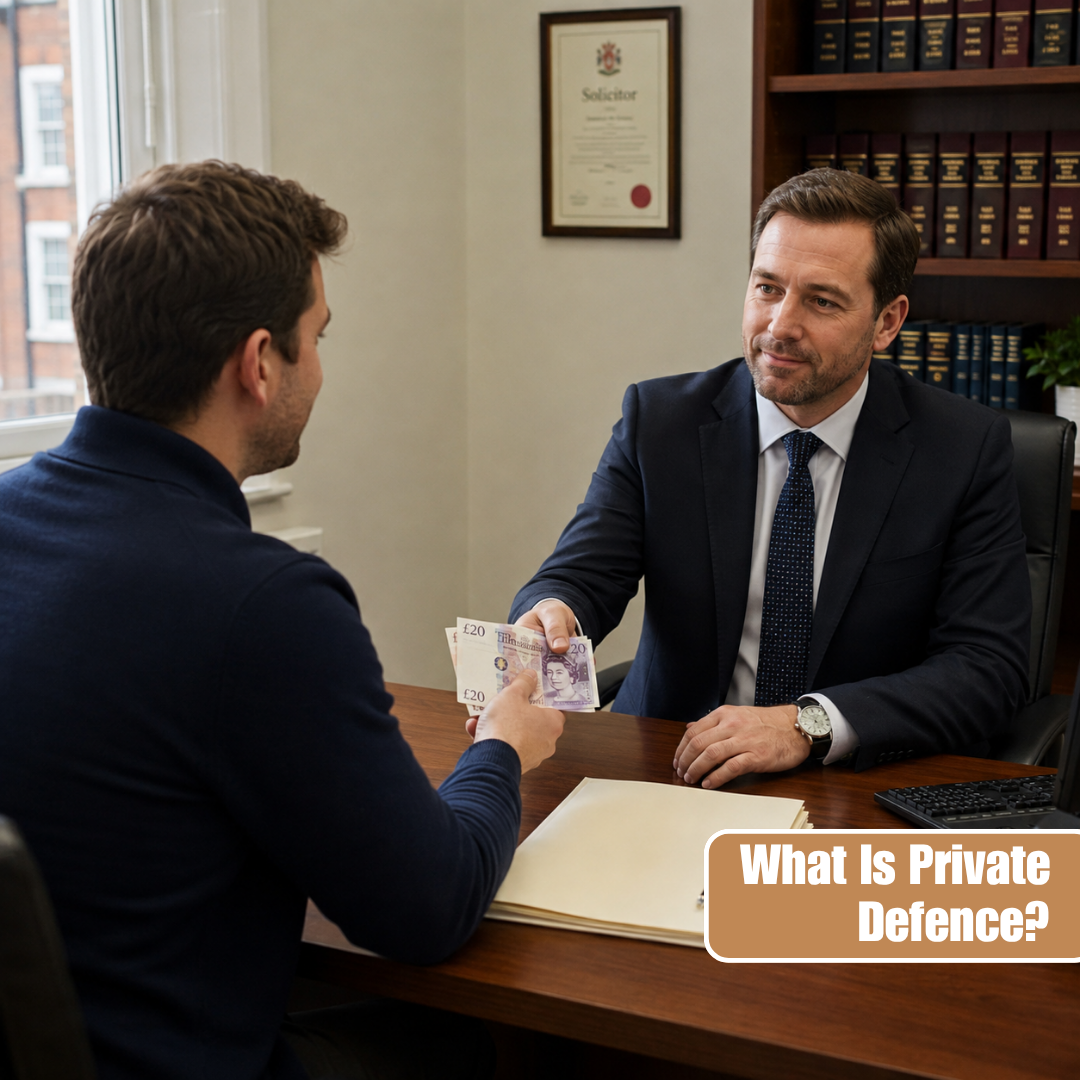
Private defence simply means you instruct and pay for your own solicitor, without going through the legal aid system.
How Does Private Legal Representation Work?
You choose the firm. You agree to the fees. You pay for the work as the case progresses, either hourly, at a fixed rate, or through some other arrangement the family solicitor proposes.
Before instructing anyone, it's sensible to ask for a clear written estimate of costs, including what happens if the case runs longer than expected or goes to a higher court.
Why Might Someone Choose a Private Solicitor?
A few reasons come up again and again.
Some people want a specific solicitor or family lawyers with a track record in a particular type of case. Others simply don't qualify for legal aid but still want proper representation. There's also the appeal of having more say over how the case is handled, since you're the paying client rather than working within legal aid's scope rules.
What Are the Main Costs?
Private representation can involve several separate costs, including:
- Solicitor's fees
- Barrister's fees, if the case needs one
- Court fees, where applicable
- Expert witness costs, if evidence from a specialist is needed
Fees vary enormously depending on the complexity of the case and how long it runs. A straightforward matter resolved quickly will cost far less than a complex case that ends up in the Crown Court.
If your legal matter also involves
family visas, immigration requirements can add another layer of legal advice and costs. In these situations, it is important to understand exactly what is included in your solicitor’s fee and whether separate immigration advice is needed.
Legal Aid vs Private Defence: What Are the Main Differences?
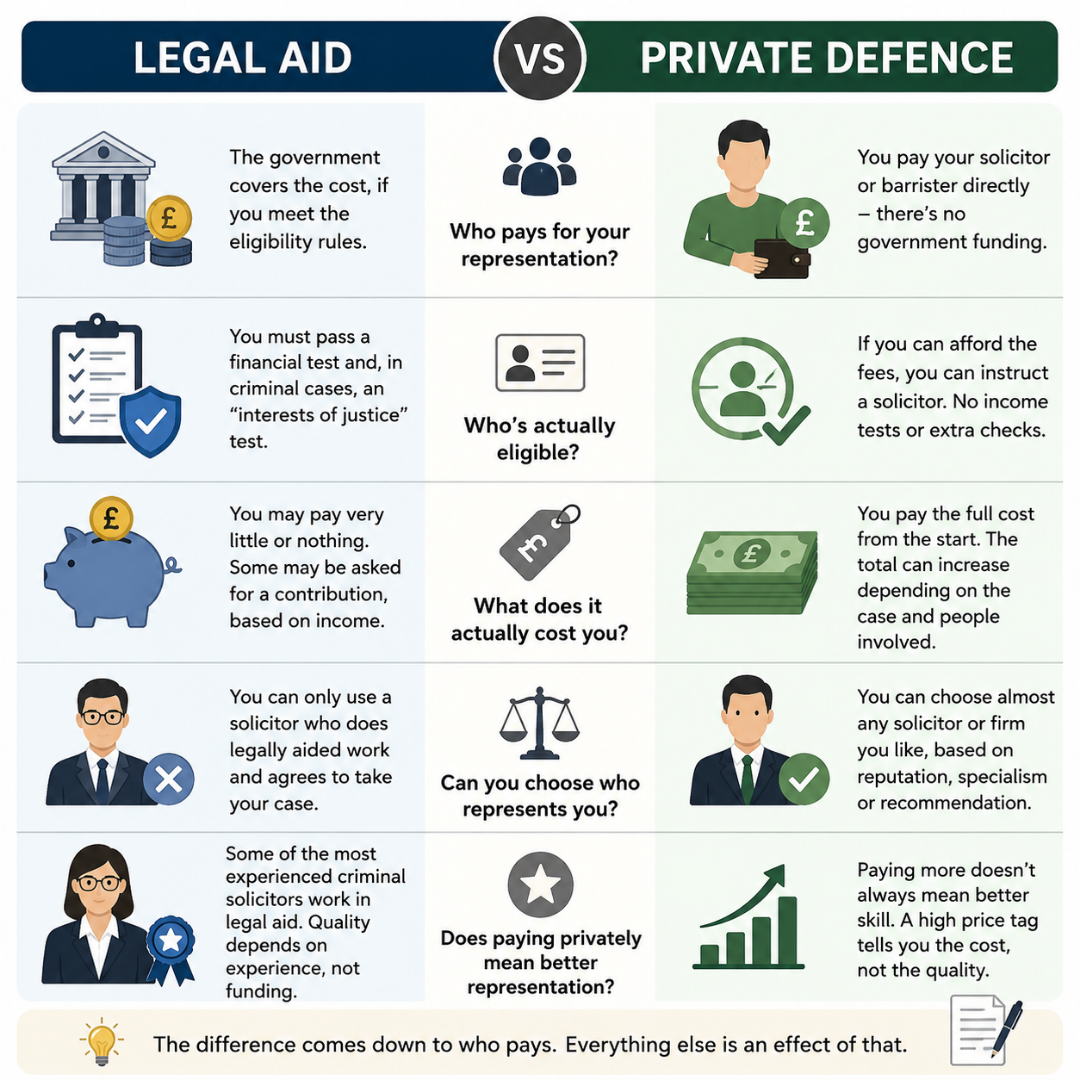
The core difference is funding. Once you understand that, everything else in this section makes a lot more sense, because each difference below is really just a knock-on effect of who's paying the bill.
Who pays for your representation?
With legal aid, the government covers the cost, provided you meet the eligibility rules. Think of it as a safety net funded by public money, designed so that lack of funds doesn't stop someone from getting proper representation. With private defence, there's no safety net. You're the one paying the solicitor or barrister in the same way you'd pay any other professional for their time and expertise.
Who's actually eligible?
Legal aid isn't something you can simply request. You have to pass a financial test and, in criminal cases, an "interests of justice" test as well. This means the system is checking two things: can you afford to pay for yourself, and is your case serious enough that funded representation matters? Private defence skips both of these checks entirely. If you can afford the fees, you can instruct a solicitor. No forms proving your income, no waiting to hear if you qualify.
What does it actually cost you?
This is where people often assume legal aid means completely free, and private defence means expensive. It's not quite that simple. Legal aid can mean paying very little or nothing, but some people are asked to make a contribution, particularly in Crown Court cases, based on their income. Private defence means you're responsible for the full cost from the very first meeting, and that cost can grow depending on how long the case runs and how many people get involved, such as barristers or expert witnesses.
Can you actually choose who represents you?
Here's a detail a lot of people don't expect. Legal aid doesn't give you an open choice of solicitor. You can only be represented by a solicitor who does legally aided work and who agrees to take on your case. Some firms don't offer legal aid at all, which narrows your options straight away. Private defence removes that limitation. You can approach almost any solicitor or firm you like, based on reputation, specialism, or a personal recommendation, as long as they're willing and available to take your case.
Does paying privately actually mean better representation?
This is probably the most important myth to clear up. Paying for a solicitor doesn't automatically buy you better legal skill. What actually determines the quality of your representation is the solicitor's experience with cases like yours, not the size of the invoice. Some of the most capable criminal solicitors in the country do legal aid work every day. A high price tag tells you what something costs. It doesn't tell you how good it is.
The same principle applies when dealing with other legal matters, where choosing the right specialist can make a difference. For example, if you need help preparing or updating your will, a professional
will writing service can help ensure your wishes are clearly documented and legally appropriate.
Which Should You Choose: Legal Aid or Private Defence?
There's no single right answer here. It genuinely depends on your circumstances.
Consider legal aid if:
- You meet the financial and case-related eligibility rules
- You can't comfortably afford private fees
- Your case type qualifies for legal aid support
- You need representation, but cost is a real barrier
Consider private representation if:
- You don't qualify for legal aid
- You want a particular solicitor or specialist for your case
- You can reasonably afford the fees
- You want more flexibility over how your case is managed
Before You Decide
A few practical steps can save you time and worry later on.
Check whether your case qualifies for legal aid before assuming it doesn't. Ask any solicitor directly about eligibility and possible contributions. If you're considering going private, get a written estimate before agreeing to anything, and ask exactly what's included in that quote. Compare a couple of solicitors' relevant experience with cases like yours, not just their prices.
The same approach applies if your legal needs later extend beyond criminal defence, particularly in workplace disputes. Speaking to experienced employment lawyers can help you understand your options and the likely costs before deciding how to proceed.
If you're also comparing how you want to access legal services, it's worth considering whether an online solicitor or a traditional law firm is the better fit for your situation. Our guide to
Online Solicitors vs Traditional Law Firms: Which Is Better in the UK? explores the key differences to help you make an informed choice.
Conclusion
At its heart, this comes down to one distinction: legal aid is publicly funded. Private defence is self-funded. Neither is automatically the better route, no matter what the internet forums might suggest.
The right choice depends on your eligibility, your finances, the type of case you're facing, and how much say you want over who represents you. If you're unsure where you stand, speak to a solicitor early. Most will tell you honestly whether you're likely to qualify for legal aid before you've spent a penny finding out.
If you're currently weighing up your options and want to talk through what applies to your specific case,
Fosters Legal Solicitors can help you understand where you stand and what to do next.
Frequently Asked Questions
What is the difference between legal aid and private defence?
Legal aid is government-funded legal assistance available to people who meet financial and case-related eligibility rules. 'Private defence' means paying a solicitor or barrister yourself, without going through the legal aid system. The main differences involve cost, eligibility and how much choice you have over your solicitor.
Is legal aid completely free in the UK?
Not always. While some people receive legal aid without paying anything, others are asked to make a contribution based on their income, particularly in Crown Court criminal cases. Civil and family legal aid can also come with conditions, such as a charge on money or property recovered through the case
Can you choose your own solicitor if you receive legal aid?
To some extent, yes, but your choice is limited to solicitors who carry out legally aided work and are willing to take on your case. This is different from private representation, where you can approach almost any solicitor you like, subject to their availability and fees.
Is a private solicitor better than a legal aid solicitor?
Not automatically. The funding method doesn't determine skill or quality. What matters more is the solicitor's relevant experience, their track record with similar cases, and how well they understand the specifics of your situation.
Who is eligible for legal aid in the UK?
Eligibility depends on your financial circumstances, the type of case, and, for criminal matters, whether it's in the interests of justice for you to receive funded representation. Civil and family legal aid have their own separate scope and financial rules.