
How Conveyancing Solicitors Make Transfer of Equity Simple and Legal?
How Conveyancing Solicitors Make Transfer of Equity Simple and Legal?

Changing the names on a property's title deeds sounds like paperwork. It rarely is.
A transfer of equity solicitor is required to deal with the intricacies and technicalities involved in the process. A transfer of title deeds can be a simple process, which is rarely the case due to the various legal, taxation and mortgage issues that may arise.
Conveyancing solicitors deal with all aspects from mortgage lender approvals and Stamp Duty to legal declarations and Land Registry formalities necessary to make sure the equity transfer is legally binding and effective.
This article explains what solicitors do when dealing with an equity transfer, how much it costs and how to choose the best one for your case.
What is a Transfer of Equity?
An equity transfer usually refers to transferring or changing the legal ownership of a property or a share of the property without selling the home, whereas a sale refers to transferring legal ownership of a property for a price.
There are many reasons why an equity transfer may need to happen, for instance, when divorcing couples want the ex-spouse's name off the deeds or mortgage, when a married couple wants to add their partner to the title deeds, buying a share in a property from another owner, or a landlord buys out their commercial tenant.
Other reasons may include transferring title deeds to a parent, buying out a friend's share, or passing on shares as part of an estate plan or inheritance.
If the transfer of property is in any way connected to financial or family-related matters, it is advisable to consult
family solicitors since they can advise on the possible consequences such transactions may have for other parties involved and help protect their rights.
When Do You Need a Conveyancing Solicitor for Equity Transfer?
An equity transfer solicitor can be engaged in a wide variety of scenarios, including the following:
Divorce or Separation
One of the most common reasons for initiating an equity transfer and engaging a property lawyer.
Marriage or Civil Partnership
Many soon-to-be-married couples decide to get on the same page regarding property matters.
Adding a Partner to a Property Deed
With an increasing number of cohabitating couples, many people opt to add their partner to their property deeds.
Removal of a Joint Owner
Sometimes a joint owner needs to be removed from the property deeds for various reasons.
Buying Out a Co-owner
Paying the share of a co-owner and becoming the sole owner of a property is also a common scenario.
Transferring Property Between Family Members
Transferring property between parents and children and between siblings is also done through an equity transfer.
Estate Planning or Inheritance
Some people engage a property solicitor to help them transfer property between family members as part of an estate plan.
Some people employ property solicitors to deal with the exchange of property as part of their long-term estate planning. It is often advisable to obtain further advice from
will writing solicitors concerning the manner in which property should be transferred so that their wishes are fulfilled and so that their estate planning is coherent. By arranging for the transfer of property in connection with a will, it is possible to prevent disputes and associated problems by making it easier for loved ones to deal with an estate
Why is Equity Transfer More Than Just Changing the Title Deeds?
While it is simple to assume that an equity transfer is just a paperwork process, the truth is that many pitfalls and complexities may arise.
One of the main reasons for consulting a conveyancing solicitor is that they help with legal ownership versus registered ownership.
Another common misconception about an equity transfer is that the mortgage payments stop upon the change of ownership, whereas, in reality, the mortgage company needs to formally agree to any alterations in ownership.
Furthermore,
legal solicitors have to consider Stamp Duty, HM Land Registry requirements and the overall legality of such a transfer, while all parties involved have to formally consent to the transaction.
How Can Conveyancing Solicitors Help With Equity Transfer?

Explain Your Legal Options
The lawyer should explain the options open to you depending on your specific situation.
Review Your Property Ownership
Reviewing your situation can help determine existing legal liabilities.
Communicate With Your Mortgage Lender
Solicitors can make sure that the mortgage company formally agrees to the equity transfer.
Prepare Legal Documents
The TR1 transfer deed gets drafted, along with a deed of trust where ownership percentages need to be recorded precisely.
Calculating Stamp Duty Land Tax (if Applicable)
Solicitors can calculate the amount of stamp duty if any is due.
Completing Identity and Compliance Checks
Anti-money-laundering rules apply to conveyancing transactions, so identity verification isn't optional, whoever's involved.
Registering the Ownership Change With HM Land Registry
The final step is the one that makes the new ownership legally official rather than just agreed upon between the parties.
Although a transfer of equity is primarily concerned with land law, it can often be part of a wider set of circumstances, including a career move or relocation following retirement or divorce. In these situations you might also need the assistance of
employment solicitors in relation to any new post, settlement agreement or redundancy package and the impact on your finances. The right legal advice across a range of areas can ensure that you understand and mitigate any potential issues.
What Legal Checks Do Conveyancing Solicitors Do?
- Identity verification for every party
- Ownership and title checks
- Mortgage account checks
- Bankruptcy searches, where relevant
- Review of any restrictions on the property
- Confirmation of consent from everyone with an interest
Skipping any one of these can unravel a transfer months later — a restriction missed on the title, for instance, can block registration entirely.
Keeping your paperwork organised can significantly aid in the process and prevent any avoidable issues. From title deeds and mortgage documents to ID checks, having all paperwork required for conveyancing at hand is essential for making sure that your solicitor can do each step of the transfer of equity process smoothly and without delays. You can learn more about
the importance of keeping your legal paperwork, including how organisation can assist you in the long run.
How Solicitors Help If There's a Mortgage on the Property
When a property is under mortgage, an equity transfer is slightly more complex since the mortgage lender is involved.
In most cases, the mortgage company needs to give formal consent to the equity transfer.
This approval is not automatic, as the mortgage lender will review the financial capabilities of the person staying in the property and continue to hold them responsible for the mortgage payments.
If it is an equity transfer without a mortgage, then the solicitor's job is slightly easier.
What Documents Are Required for an Equity Transfer?
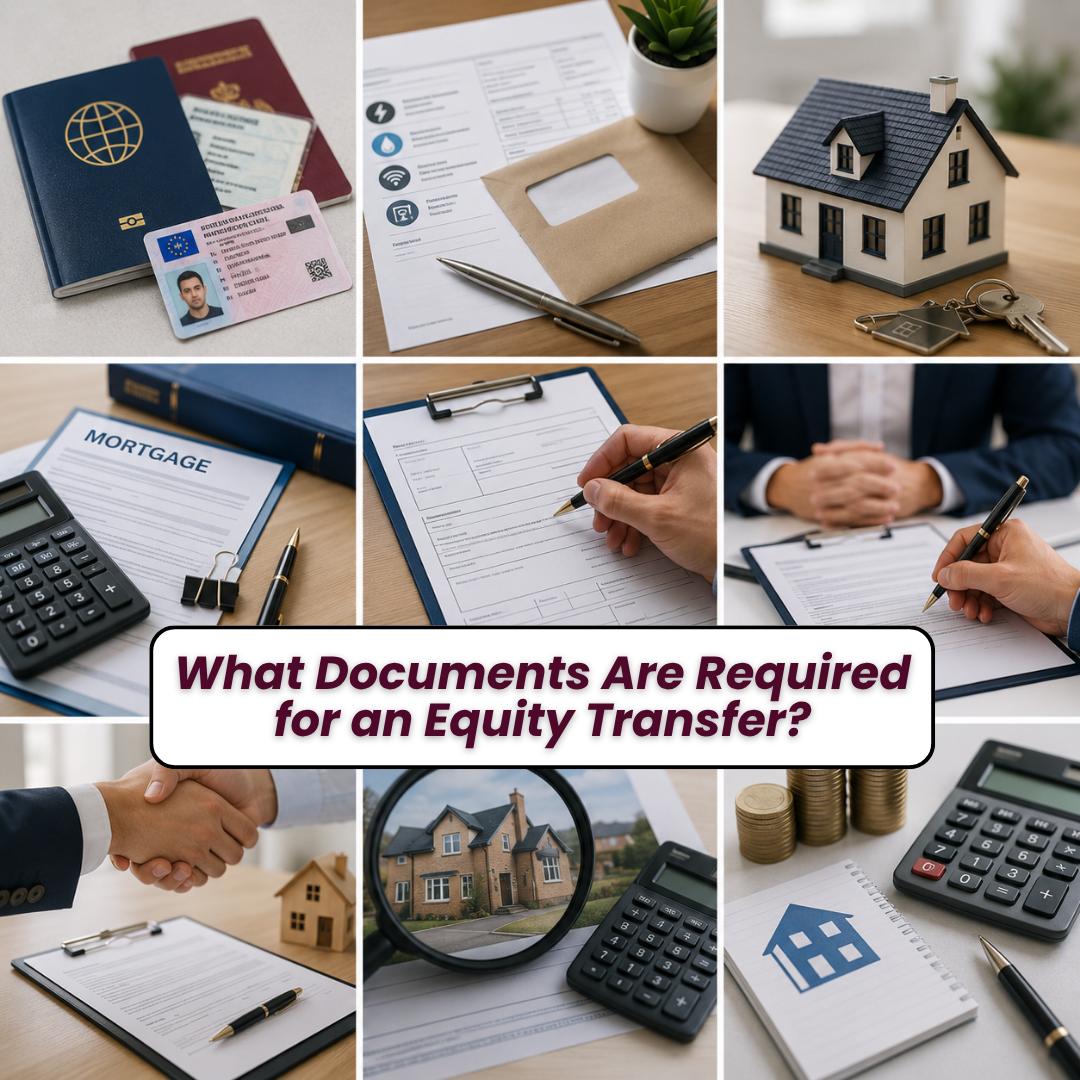
Documents and their purpose for an equity transfer:
Proof of Identity
Completion of anti-money laundering checks.
Proof of Address
Confirming your address and other personal information.
Title Information
Confirming existing ownership of the property.
Mortgage Information
Assessing lender requirements.
TR1 Equity Transfer Form
This is the formal legal document required when transferring property.
Mortgage Lender Consent
This is required when a property is mortgaged.
Valuation of the Property
This is necessary when calculating stamp duty, if applicable.
Stamp Duty Information
This helps determine how much stamp duty, if any, is due on the equity transfer.
Common Legal Risks of Handling an Equity Transfer Without a Solicitor
- Invalid or incorrectly prepared legal documents
- Lack of mortgage lender's consent
- Delays or rejection when registering the transfer by the land registry
- Inaccurate Stamp Duty calculations
- Disputes over property ownership
- An equity transfer that is not properly registered with the Land Registry
- Legal issues surfacing years later when trying to sell the property
How Long Does the Process Usually Take?
The whole process can take anywhere between two and four weeks if there is no mortgage involved, or six to eight weeks if there is a mortgage.
Registering the equity transfer with the Land Registry can also take a few weeks or several months on top of the aforementioned period.
Conveyancing Solicitor Cost for Equity Transfer
The following costs are usually associated with an equity transfer:
Solicitor Fees
Usually ranges between £150 and £600, depending on lender approval and other factors.
HM Land Registry Fees
These vary between £20 and several hundred pounds, depending on the value of the property.
Mortgage Company Fees
Between £100 and £300.
Stamp Duty
Varies depending on the mortgage value.
Property Valuation Fee
Varies depending on the property, but between £150 and £300 in most cases.
Overall costs vary a fair amount depending on how many parties are involved and whether a mortgage complicates matters.
How to Choose the Right Conveyancing Solicitor
- Look for conveyancing solicitors with specialist knowledge and experience in equity transfer matters, not just general property conveyancing.
- Ask them to provide transparent, itemised quotations rather than vague figures.
- Ask for testimonials and reviews from clients who have had similar requirements, such as divorce, family transfers or buy-to-let transfers.
- Make sure they are regulated by the Solicitors Regulation Authority or Council of Licensed Conveyancers.
- Ask how they communicate with you – some solicitors offer email communication only, whereas others offer more flexible options.
- Ask if they have experience in dealing with your mortgage company, as some lenders are more demanding in their requirements than others.
Conclusion
A transfer of equity enables a property's legal ownership to be transferred without selling it.
Conveyancing solicitors deal with mortgage lenders' requirements, stamp duty, property title, Land Registry formalities and other legal aspects of an equity transfer.
An equity transfer is a relatively simple procedure, usually taking between two and four weeks if there is no mortgage involved, or up to eight weeks or longer if there is a mortgage.
An equity transfer solicitor is important since the mortgage lender usually needs to give formal consent to the transfer and all other legal aspects should also be reviewed by a qualified professional.
If you are considering initiating an equity transfer, it is a good idea to contact Foster Legal Solicitors for an experienced conveyancing solicitor well in advance of actually finalising any arrangements or agreements with the other party(ies) involved.
Frequently Asked Questions
Do You Need a Conveyancing Solicitor for Equity Transfer?
While an equity transfer is not illegal without a solicitor, most mortgage lenders require a conveyancing solicitor to handle the legal work and deal with their requirements for an equity transfer.
Can You Transfer Equity to Yourself?
Yes, but only if there is no mortgage involved, since a mortgage lender will require a solicitor to deal with the change of ownership
Will Your Lender Insist on a Solicitor?
Yes, most likely, as the mortgage lender will want a solicitor to make sure that the borrower fully understands their obligations under the mortgage contract.
How Long Does Equity Transfer Take?
An equity transfer, on average, takes between two and four weeks if there is no mortgage involved, whereas an equity transfer with a mortgage may take between six and eight weeks on average.
Can Ownership of a Property Be Transferred Without Selling It?
Yes, that is essentially what an equity transfer is.