Who Inherits Your Assets if You Die Without a Will UK?
Who Inherits Your Assets if You Die Without a Will UK?
Leaving your estate to chance is a risk many unknowingly take. If you die without a will UK, UK law does not ask your family to decide who gets your home, savings, and personal belongings through strict inheritance rules. Unmarried partners could end up with nothing, stepchildren are routinely left out, and the government steps in to control the rest. It follows a fixed set of rules, and those rules can leave the person you love most with nothing.
Taking a few minutes to write a will ensures your loved ones are actually protected.
Roughly six in ten UK adults don't have a will, and most of them assume the outcome will simply be "fair". It often isn't. Below, we'll walk through exactly who inherits when there's no will, who's left out entirely, and what you can do about it before it becomes someone else's problem to sort out.
What Does "Dying Intestate" Actually Mean?
Dying intestate simply means dying without a valid will. That covers two situations: never writing one at all, or writing one that a court later throws out because it wasn't signed correctly, wasn't witnessed properly, or was drafted in a way that doesn't hold up.
When that happens, England and Wales fall back on the Rules of Intestacy, a framework built on the Administration of Estates Act 1925 and updated several times since. It's worth being clear about the geography here too. Scotland and Northern Ireland run different systems entirely, so a guide written for England and Wales won't map neatly onto a Scottish estate.
There's also a quieter cause worth flagging: wills that go missing. A will only counts if the executor or family can actually locate it.
Legal solicitors see this more often than you'd expect. A will was written years ago, stored in a drawer or with a firm that's since closed, and nobody can find it when it matters. The estate is then treated exactly as if no will existed.
Who Inherits Under the Intestacy Rules?
Think of the intestacy rules as a queue. Each group only receives anything if everyone ahead of them in the queue is absent. It sounds rigid because the law isn't comparing who needs the money most or who was closest to the person who died.
Spouse or Civil Partner, Plus Children
This is the scenario most families actually fall into, so it's worth getting right. Where someone leaves a spouse or civil partner and children, the spouse takes the personal belongings, then a fixed sum known as the statutory legacy, currently £322,000 off the top. Whatever's left is split in half: one half to the spouse, the other shared equally among the children.
So if the estate is worth £322,000 or less, the spouse gets it all, and the children get nothing straight away. Only once you go above that threshold do the children see anything under intestacy. This rigid distribution often catches grieving families off guard, which is why consulting experienced
family law solicitors is crucial for structuring an estate plan that truly protects both your partner and your children.
Spouse, No Children
Here it's simpler. With no children in the picture, the surviving spouse or civil partner inherits everything.
No Spouse
If there's no surviving spouse or civil partner, the estate passes to the children in equal shares. Where a child has already died, their own children (the deceased's grandchildren) step into that share.
No Spouse and No Children
The order then moves through parents, then siblings (and half-siblings if there are no full siblings), then grandparents, then aunts and uncles, each tier only inheriting if the one above it has nobody living.
Nobody at All
If genuinely no qualifying relative can be traced, the estate passes to the Crown. This is called bona vacantia, and it's more common than people assume, particularly among those who die without close family and never get round to writing a will. Working with experienced
will writing solicitors prevents this outcome entirely, ensuring your hard-earned assets go to the charities, friends, or causes you actually care about rather than defaulting to the state.
Who Gets Nothing? The Part Most People Don't See Coming

This is usually the moment clients go quiet in a first meeting. The intestacy rules leave out entirely some of the closest relationships a person can have.
Unmarried and Cohabiting Partners
Unmarried and cohabiting partners inherit nothing automatically, no matter how long the relationship lasted. Twenty years together, a shared home, or biological children – none of it creates an automatic legal right to inherit under intestacy. The only route open to a partner in that position is a claim under the Inheritance (Provision for Family and Dependants) Act 1975, which means going to court and asking a judge to award reasonable financial provision. It can work, but it's slower, more stressful, and far from guaranteed compared with simply being named in a will.
How mirror wills fix this for cohabiting couples
For unmarried couples, mirror wills are the standard, low‑cost way to override intestacy and ensure the surviving partner inherits. A mirror will is one of a pair of separate wills made by two partners where the terms are essentially the same – typically, each leaves everything to the other, then to children or other beneficiaries if both have died.
Because each will is independent, either partner can change theirs later, but while both are in force, they give the survivor a clear, automatic right to inherit – avoiding the need to rely on a 1975 Act claim. For cohabiting couples in England and Wales, mirror wills are often described as essential precisely because, without them, the partner gets nothing under the intestacy rules.
Stepchildren
Stepchildren are treated as though they're not related at all, unless they were legally adopted. Plenty of people raise a partner's children as their own for decades without ever formalising an adoption, and the law doesn't recognise that bond. If you want a stepchild to inherit, a will is the only reliable way to make that happen.
Friends, Godchildren, and Charities
Friends, godchildren, and charities you may have wanted to support don't get a look-in either. Intestacy only recognises blood relatives, adopted children, and spouses or civil partners.
There's a property wrinkle here too. If a couple owns a home as joint tenants, the survivor automatically inherits the whole property regardless of a will – that's called the right of survivorship. But if they own it as tenants in common, each person's share is treated as part of their own estate and follows the intestacy rules instead.
Plenty of cohabiting couples don't actually know which of the two applies to them until it's tested, which is exactly the wrong time to find out. Using a professional
will writing service can help you clarify your ownership status early on and ensure your share of the property passes to the right person.
The Practical Fallout Nobody Warns You About
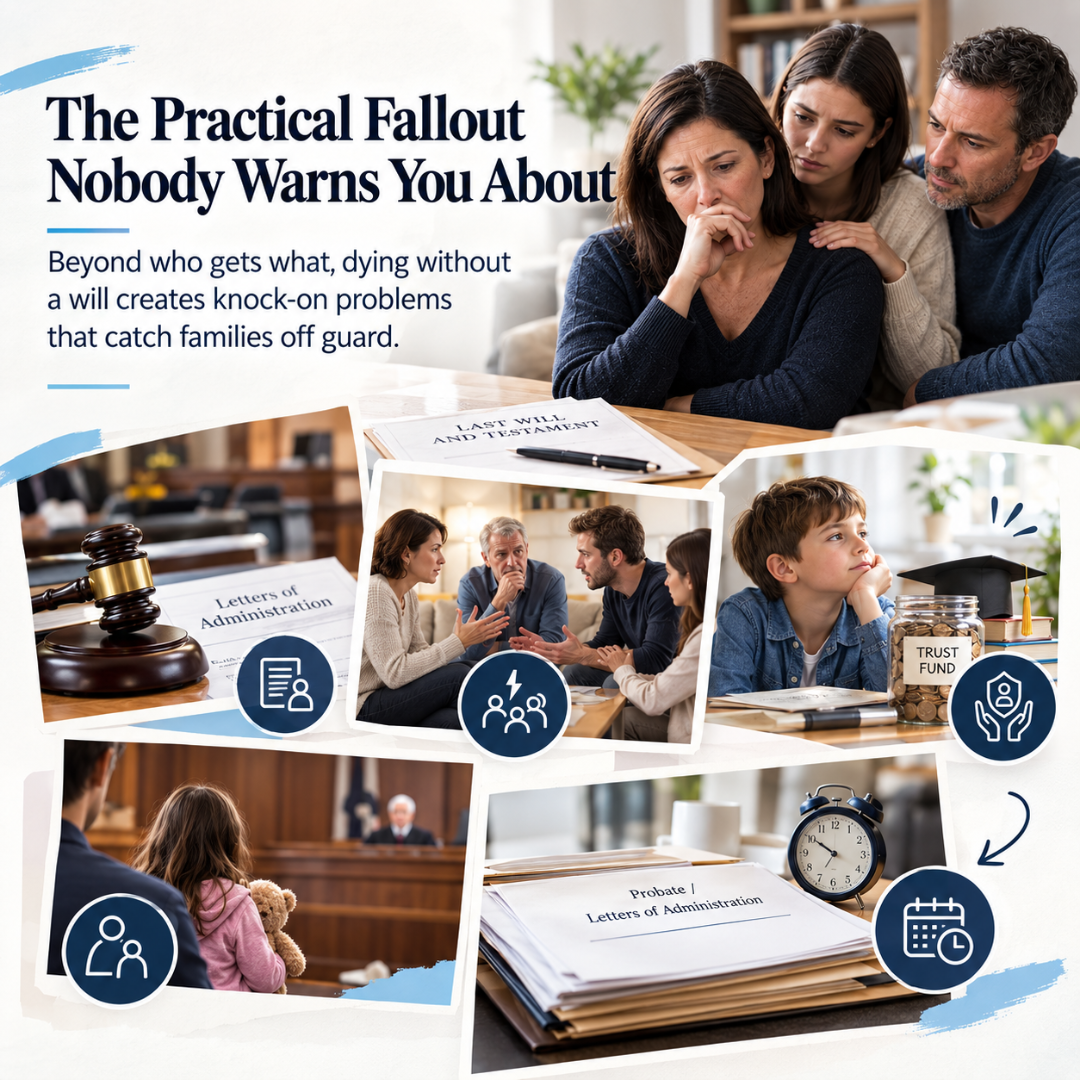
Beyond who gets what, dying without a will creates knock-on problems that catch families off guard.
There's no executor named, so nobody has automatic authority to deal with the estate. Instead, a family member has to apply to become the "administrator" and be granted Letters of Administration by the probate registry, a different, often slower process than the Grant of Probate used when a will exists.
Disputes crop up more often too. Without written instructions, families are left guessing, and guessing under grief rarely goes smoothly.
Best solicitors in UK who handle contentious probate will tell you that intestacy cases generate a noticeably higher share of family disagreements than estates with a clear will in place.
Money left to children under 18 doesn't go straight to them. It's held in a statutory trust until they turn 18, managed according to fixed rules rather than how you might actually want it handled—such as funding school fees, staggering payouts, or setting milestone support. Consulting experienced local will writing solicitors allows you to outline flexible trust terms tailored to your family's specific goals.
And separately from money entirely: intestacy says nothing about who looks after your children if you die while they're still young. Appointing guardians is legally decided through a properly drafted will; without one, that critical choice falls to the family court, not the intestacy rules.
These delays and procedural hurdles inevitably prolong the administrative timeline for grieving families. To understand the realistic timeframes involved in securing Letters of Administration or Grants of Probate, read our full guide on probate timelines in the UK.
Points to Remember
- Dying intestate means the Rules of Intestacy, not your own wishes, decide who inherits.
- A spouse or civil partner with children receives personal belongings, the £322,000 statutory legacy, and half of whatever's left; children share the other half.
- Unmarried partners and unadopted stepchildren inherit nothing automatically under intestacy.
- Jointly owned property passes differently depending on whether it's held as joint tenants or tenants in common.
- Administration is typically slower and more prone to disputes than when a valid will is in place.
- A will is the only way to guarantee your estate goes where you actually want it to.
That's exactly why using a professional
will drafting service makes sense: it ensures your will is legally valid, clearly reflects your wishes, and avoids the delays, uncertainty, and family conflict that often arise under intestacy.
Conclusion: Protect Your Family’s Future
None of this is really about legal technicalities. It's about who ends up carrying the weight when something happens to you. A will takes an afternoon to sort properly. Intestacy can take a family months, sometimes years, to untangle, and it can quietly write a partner or a much-loved stepchild out of the picture entirely. If you've read this far and know your own situation doesn't fit neatly into the "married with biological children" box the law assumes, that's usually the clearest sign it's worth getting a will in place sooner rather than later.
If you'd like to talk through your situation, the team at
Fosters Legal Solicitors Ltd can help you put a will together that actually reflects your wishes, rather than leaving it to a formula that doesn't know you.
Frequently Asked Questions
Does Your Spouse Automatically Inherit Everything if You Die Without a Will?
Only if there are no children. Where children survive too, the spouse receives personal belongings, the £322,000 statutory legacy, and half of the remaining estate, with children sharing the other half.
Do Unmarried Partners Inherit Anything Under UK Intestacy Rules?
No. Cohabiting partners have no automatic right to inherit, regardless of how long they lived together. Their only option is applying to court under the Inheritance (Provision for Family and Dependants) Act 1975.
What Happens to a Jointly Owned House if There's No Will?
It depends on how it's owned. Property held as joint tenants passes automatically to the surviving owner. Property held as tenants in common is treated as part of the deceased's estate and follows the intestacy rules.
Can Stepchildren Inherit if There's No Will?
Only if they were legally adopted by the deceased. Stepchildren who weren't formally adopted have no automatic entitlement under intestacy
What Happens if There Are No Living Relatives at All?
The estate passes to the Crown, a situation known as bona vacantia.