
What Is a MIAM? Your UK Family Law Guide
What Is a MIAM? Your UK Family Law Guide

Resolving family disagreements can take an emotional toll, particularly if there are kids involved or if there are financial issues at stake. And while some might think the only option is heading straight to court, that doesn’t have to be the case.
In fact, in England and Wales, most people are expected to try mediation before launching court proceedings. This means knowing what is a MIAM entails has never been more vital.
A Mediation Information & Assessment Meeting (MIAM) is typically the initial stage in the process of family dispute resolution. However, instead of being used as a way of determining the outcome of your case, this is a chance to understand how mediation could work and whether it’s right for you.
Mediation can help people in families come up with practical solutions to their issues that don’t involve going through courts.
But it’s not suitable for all types of situations, and there are some areas where you’re legally exempt from attending a Mediation Information and Assessment Meeting (MIAM).
Whatever your situation—whether you’ve talked to a family solicitor, you’re looking into using mediation yourself, or you want to find out about how the law works—we'll give you clear info on what you need to know here.
What Is a MIAM?
If you are required to go to a MIAM (Mediation Information and Assessment Meeting), you will have a confidential meeting with an accredited family mediator before making some applications to the family courts.
This is not a mediation session itself but a chance for you to find out about how mediation works and if it’s likely to enable you to come up with a resolution of your own.
During the meeting, the mediator will:
- Explain what happens during family mediation, such as discussing your issues and assessing whether it's right for anyone else involved.
- You will also cover any safeguarding or safety concerns we may have and explore other options should family mediation not be an appropriate option.
The goal is to equip people with sufficient information to enable them to decide on their next steps—which can sometimes involve making expensive applications to court.
Why Is a MIAM Required?
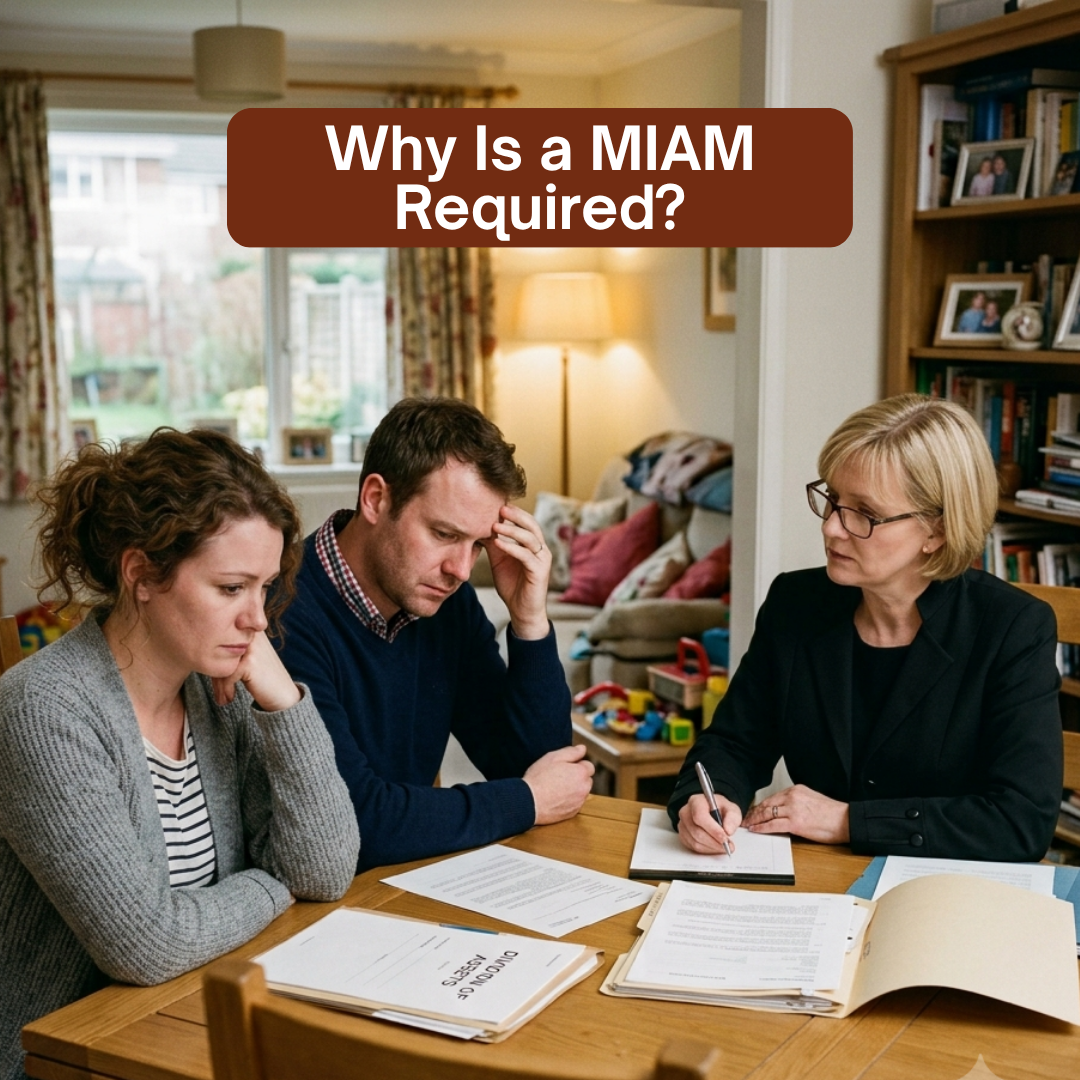
The main goal of family courts is to encourage separating couples to settle their issues outside of court as much as they possibly can.
After all, going through court proceedings can get pretty pricey for both parties, taking up lots of time from your schedule while you’re trying to get things done around the house at the same time. And if you have kids, these kinds of situations tend to become even more emotionally taxing than usual! Many family courts will seek to resolve any dispute between separating parties as outside of court as much as possible. Court hearings can be costly, take a long time, and be extremely emotional and difficult – particularly where children are involved. This is why attending a MIAM is a prerequisite to making certain applications in the family court system. It is an opportunity for separated families to consider mediation as an initial avenue, which often has quicker and more efficient results.
We included this as an incentive for people to think about whether mediation might offer a quicker and less confrontational way of resolving their issue.
Mediation can often help families.
- Agree faster—Reach agreements more quickly.
- Save money—reduce legal costs.
- Communicate better—improve communication.
- Concentrate on solutions—focus on practical solutions.
- Minimise conflict for children – Minimise conflict for children
If mediation isn’t appropriate or if it doesn’t lead to an agreement, then you will generally have the opportunity to continue with your court application.
What Happens During A MIAM?

Your appointment will last between 45 minutes and one hour—although this can be longer if there's more to discuss. Most MIAMS take place individually (you won't go through them together).
The mediator will ask questions about your situation and what you need help resolving – for example,
- child arrangements
- financial matters
- property
- other problems that have come up since you separated from your spouse.
You’ll be given an overview of what happens during mediation, including how your next session(s) will be arranged and what you might hope for if both parties agree to carry on with mediation.
You must be able to discuss whether mediation is suitable for your particular case—this could involve considering several elements, like the following:
- Domestic abuse
- Child safeguarding concerns
- Urgent legal issues
- Power imbalances between the two parties
- Whether there’s mutual agreement to take part
The mediator should also explain what happens at the end of your meeting. This could be anything from asking if you’d like them to invite the other party along to their own MIAM, to suggesting you might benefit from some more mediation sessions—or saying they don’t think you’ll benefit from mediation and telling you what you need to provide to the court.
Who Needs to Attend a MIAM?
In many family law cases, the person making the court application must attend a MIAM before proceedings can begin.
This commonly applies to disputes involving:
- Child arrangements
- Financial settlements after separation
- Property disputes
- Parental responsibility
- Other private family law matters
Each person would normally meet their mediator separately and have the freedom to voice themselves freely in privacy.
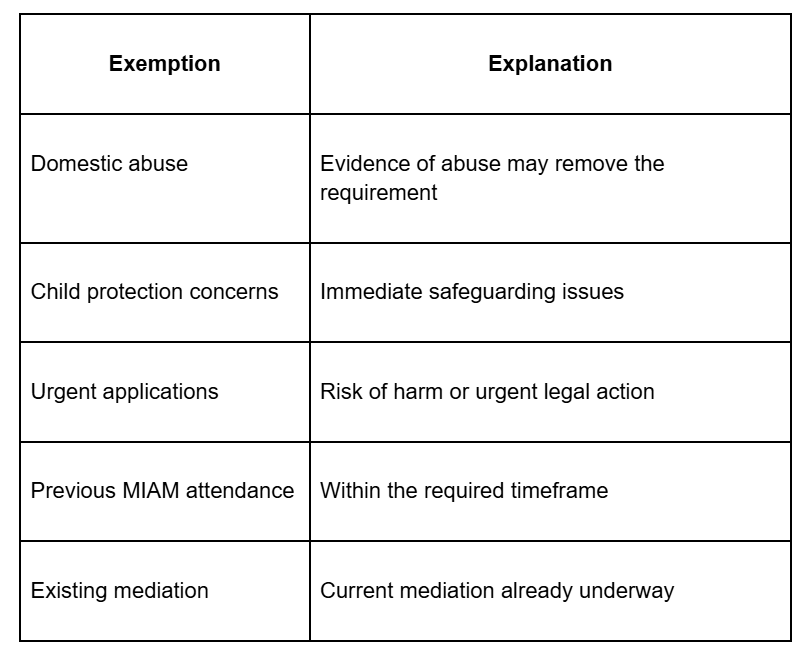
When Are You Exempt from Attending a MIAM?
Not everyone must attend.
Common exemptions include
A
family solicitor can advise whether your circumstances qualify for an exemption.
MIAM vs Family Court
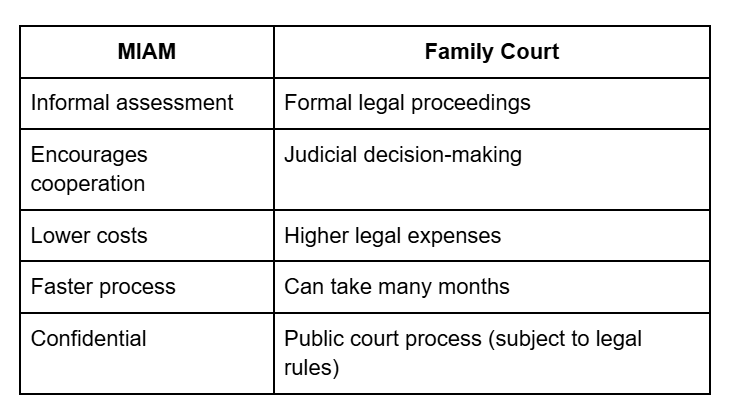
For many families, mediation provides more flexible and practical solutions than litigation
Benefits of Family Mediation

Choosing mediation after a MIAM can offer significant advantages.
Lower legal costs
It’s generally much more affordable to work out a dispute through mediation than through the courts. Mediation is
affordable and can save your time if done with a good solicitor firm or legal advisor.
Faster resolutions
Many mediation cases conclude within weeks rather than months.
Better communication
Parents often develop healthier communication for future co-parenting
Greater control
A judge does not decide for parents—the parties themselves arrive at solutions agreeable to all involved.
Child-focused decisions
The mediation process fosters settlements based on what is best for your children. Mediation is good for your child during
high conflict because it focuses on the child's rights and well-being.
How Should You Prepare for a MIAM?

Before attending:
- Gather relevant financial documents if finances are involved.
- Prepare a timeline of the dispute.
- Think about your preferred outcomes.
- Make a list of questions.
- Inform the mediator about any safety concerns.
Being prepared allows the mediator to assess your circumstances more effectively.
Conclusion
Knowing what a MIAM is could save you a huge amount of time, stress and even expense throughout the family law procedure. MIAM is basically a trial at the Family Court that you can try as an alternative solution to going to court to address family law matters such as issues with childcare or financial settlements between married couples. A family court could encourage you to complete this procedure to settle any issues with your partner, and if that fails, then court could be your only avenue.
The primary aim of a Mediation Information and Assessment Meeting (MIAM) is to provide people with information about how mediation could work for them by helping their entire family explore options without going to court. However, this process isn’t appropriate for all cases, but if someone chooses to attend a MIAM, they can then make an informed choice on whether they want to proceed further or not.
It’s vital that those who are dealing with problems such as child arrangements, financial settlements, or separation issues consult the experts with
legal solicitors, who will be able to advise and explain their options effectively to protect their rights accordingly.
Need Advice About a MIAM?
At our firm, Fosters Legal Solicitors, we know all family situations are unique. We offer expert family law advice covering family mediation, divorce, child arrangements, financial settlements, and other relevant areas of family law.
Our professional team can give you guidance, whether this is from a
family solicitor, through mediation, Will writing services Watford, or an
employment lawyer in Watford. Or if you require any
immigration solicitors legal aid issues, please get in touch. Contact us today at
Fosters Legal Solicitors to talk through your situation and get expert, trustworthy legal guidance that's perfect for you.
Frequently Asked Questions
Is attending a MIAM compulsory?
If your case involves a lot of money, then yes, but if you’re taking a case to court about things like child arrangements or finances, for example, then you’ll normally have to go along to a MIAM.
There are also exemptions—if, for instance, you’ve been subject to domestic abuse or you have child protection concerns, you can apply for an exemption from having to go to a MIAM. There’s also an exemption available where you make an application that has to be dealt with urgently.
Does my former partner attend the same meeting?
No—generally speaking, each party will be asked to attend their own MIAM.
The reason for this is that you will have an opportunity to speak freely with your mediator prior to any joint mediation taking place
Do I have to continue with mediation afterwards?
You don’t need to attend the MIAM if you do not want to commit yourself to mediation. The meeting gives people the chance to find out more about how mediation works and whether it’s the best way of solving their dispute
What happens if mediation isn't suitable?
The mediator may decide that mediation doesn’t seem suitable—for example, if they are concerned about safeguarding or there’s a substantial imbalance between the parties—and make sure you get the MIAM certificate you need to go ahead with your family court application if this applies to you.
How much does a MIAM cost?
The cost will depend on the provider of the MIAM service you choose as well as where you live.
Some people are also eligible to receive legal aid that could cover some or all of this cost—provided they meet certain qualifying criteria.