
How UK Family Courts Decide Child Arrangements in High-Conflict Cases
How UK Family Courts Decide Child Arrangements in High-Conflict Cases

When parents separate, disagreements about where a child should live and how much time they should spend with each parent can quickly become emotionally charged. In high-conflict cases, reaching a private agreement is often impossible, leading many families to court. Seeking advice from experienced family and child law solicitors offering trusted legal services at an early stage can often help parents understand their options before litigation becomes unavoidable
This comprehensive guide explains how UK courts decide child arrangements in 2026, what the welfare checklist means in practice, recent legal changes that affect your case, and what you can do to strengthen your position.
Child Arrangements in the UK: The Scale of the Issue (2026)
Understanding the scale of family court demand helps set realistic expectations for timelines and court resources.
New private law children's cases (CAFCASS) — Apr 2025 to Mar 2026
42,172 cases
Involving 63,879 children. March 2026 was the highest monthly demand since March 2021. Source: CAFCASS, 2026.
Cases involving domestic abuse allegations
62%
Of all private law proceedings involve at least one allegation of domestic abuse. Source: family dispute statistics, 2026.
Parties without legal representation
80%
Of private family law proceedings now have at least one unrepresented party — making early legal advice more important than ever.
⚠ 2025–2026 Legal Update
In October 2025, the UK government announced it would legislate to repeal the presumption of parental involvement — a significant shift in how courts approach contact decisions. Provisions to do so are included in the Crime and Tribunals Bill. Separately, Child Focused Courts (a reformed approach that prioritises safeguarding in domestic abuse cases) are now being rolled out nationally across England and Wales as of 2026. Any parent entering proceedings today should be aware that these reforms directly affect how judges assess risk and welfare.
What Is a Child Arrangements Order?

A Child Arrangements Order is a legally binding order issued by the Family Court under the Children Act 1989. It determines:
• Where a child will live
• When and how a child spends time with each parent
• Communication arrangements (calls, messages, visits)
• Any specific conditions tailored to the child's circumstances
The order replaced former residence and contact orders. Its primary purpose is to provide clarity, stability, and protection when parents cannot reach agreement themselves.
Why High-Conflict Disputes Reach Court
Courts actively encourage parents to resolve disputes through mediation, collaborative law, or negotiations supported by legal solicitors, helping families avoid unnecessary litigation where possible.. Court proceedings typically become necessary when:
Allegations of Domestic Abuse
Claims involving physical, emotional, psychological, or coercive control may significantly affect parenting arrangements. Courts now apply Practice Direction 12J (PD12J) in any case where domestic abuse is alleged — this sets out specific steps judges must take to assess risk and ensure any order protects the safety of the child and victim parent.
Parental Alienation Concerns
One parent may allege that the other is deliberately undermining the child's relationship with them. It is important to understand that courts no longer treat 'parental alienation' as a diagnosable syndrome. The President of the Family Division has confirmed that family judges regard the label with considerable scepticism. Concerns about one parent influencing a child's views are taken seriously, but must be supported by clear evidence rather than mere assertion.
Safeguarding Risks
Concerns about substance misuse, neglect, violence, or unsafe living conditions require judicial assessment before any contact is permitted or expanded.
Persistent Communication Breakdown
Some parents are unable to cooperate despite repeated attempts at mediation. In such cases, court orders can provide a structured framework that removes the need for ongoing direct communication.
How UK Courts Decide Child Arrangements: The Legal Framework
The answer is straightforward: the child's welfare is the court's paramount consideration. This principle is enshrined in the Children Act 1989 and governs every decision the Family Court makes.
Key Principle
Courts do not automatically favour mothers or fathers. Modern family law recognises the importance of meaningful relationships with both parents — provided this is safe and beneficial for the child. Evidence, not gender, drives outcomes.Parents who obtain advice from experienced local family law solicitors are often better prepared to present evidence that focuses on the child's welfare rather than the conflict between adults.
Rather than focusing on what parents want, judges examine what arrangement best supports the child's physical, emotional, educational, and psychological needs — assessed on a case-by-case basis. There is no standard formula.
The Welfare Checklist: What Judges Actually Consider

When making a Child Arrangements Order, courts must work through the welfare checklist in the Children Act 1989. Here is what each factor means in practice:
1. The Wishes and Feelings of the Child
A child's views are taken into account — and carry increasing weight as the child grows older and more mature. However, a child's wishes are not automatically decisive. Courts are aware that a child's stated preference may be influenced by a parent, and CAFCASS officers are trained to identify this.
2. Physical, Emotional, and Educational Needs
Judges assess schooling, healthcare, daily routines, emotional stability, and developmental requirements. Disrupting a child's school or friendships is a factor courts weigh carefully.
3. The Likely Effect of Change
Courts consider whether changing living arrangements may disrupt stability or emotional wellbeing. A child who has lived with one parent for several years may need a gradual transition rather than an abrupt change.
4. Age, Background, and Characteristics
Cultural background, religion, language, disability, and individual family history are all relevant. Courts aim to preserve important aspects of a child's identity and community ties.
5. Risk of Harm
Any evidence of abuse, neglect, domestic violence, or other safeguarding concerns receives careful scrutiny. Following the 2025–26 reforms, courts now apply a more evidence-based, individualised approach — rather than relying on broad assumptions about contact.
6. Capability of Each Parent
Judges evaluate each parent's practical ability to meet the child's needs consistently. This includes emotional availability, stability of home environment, and willingness to support the child's relationship with the other parent.
Evidence Courts Consider in High-Conflict Cases
CAFCASS Reports
The Children and Family Court Advisory and Support Service (CAFCASS) plays a central role. CAFCASS officers interview parents and children, conduct safeguarding checks, and prepare recommendations for the court. Importantly, CAFCASS advises — the final decision always rests with the judge.
What CAFCASS Looks For
CAFCASS officers assess the quality of each parent's relationship with the child, any safeguarding risks, the child's wishes (taking into account their age and maturity), and each parent's willingness to support contact with the other. Being child-focused and cooperative in your CAFCASS interview can make a material difference.
School and Medical Records
Educational and healthcare records provide objective, third-party evidence of a child's wellbeing, attendance, and development — often more persuasive than a parent's own statements.
Witness Statements
Statements from teachers, healthcare professionals, social workers, family members, or other relevant individuals may be submitted. These should be factual and specific rather than character assessments.
Police and Social Services Records
Where safeguarding concerns exist, official police call-out records and social services involvement are considered. These can corroborate or undermine allegations made by either party.
Expert Assessments
In complex cases, the court may order psychological or specialist assessments. These are expensive and time-consuming, so courts use them selectively.
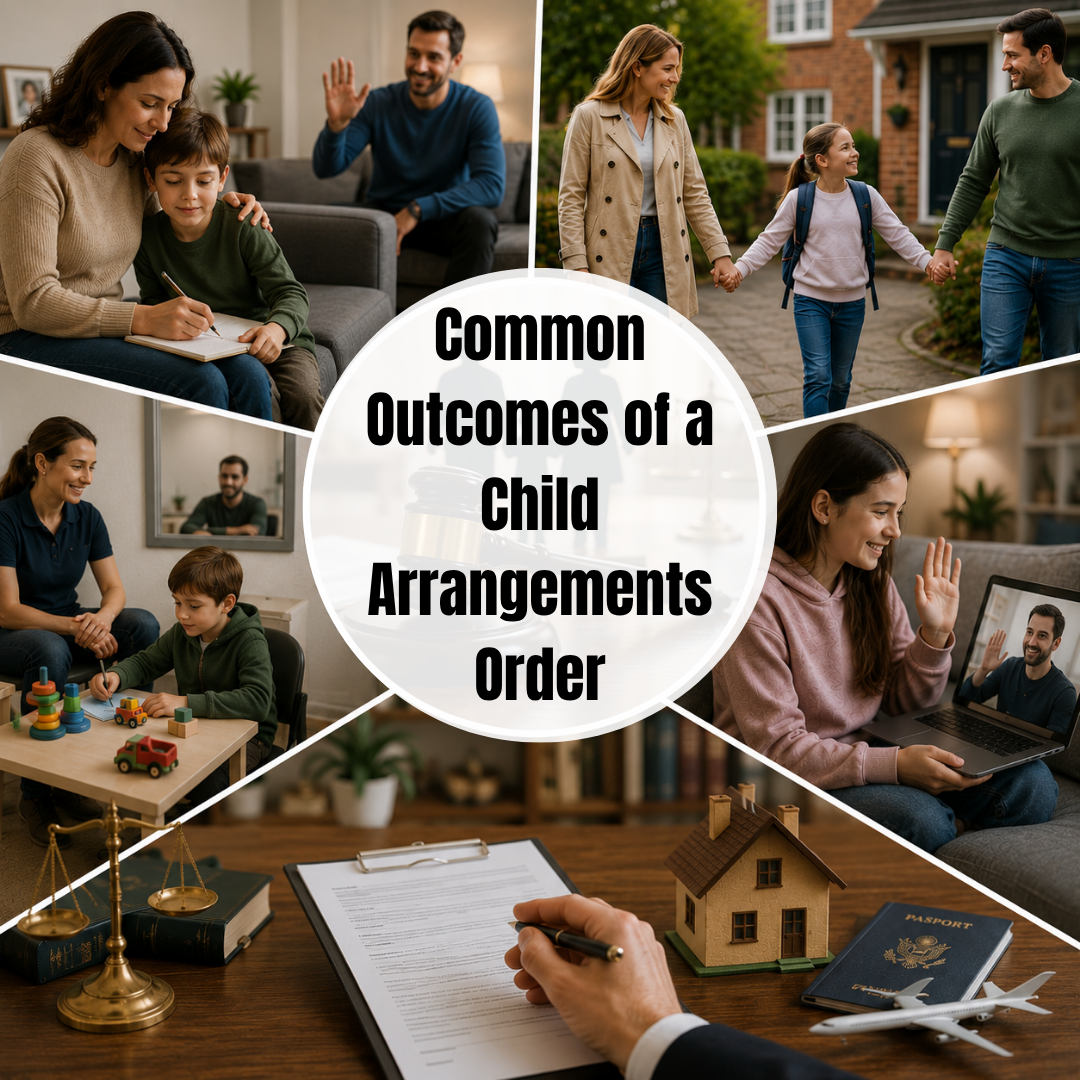
Common Outcomes of a Child Arrangements Order
Living with One Parent
The child primarily resides with one parent while spending regular, defined time with the other. This remains the most common outcome in contested proceedings.
Shared Care Arrangements
In suitable cases, children may divide their time between both parents. Shared care does not necessarily mean a 50/50 split — courts focus on what works best for the child, not on equal division for its own sake.
Supervised Contact
Where safety concerns are present but contact is in the child's interests, it may initially take place at a contact centre under professional supervision. This is often a stepping-stone to unsupervised contact as trust is established.
Indirect Contact
In cases where direct contact is not currently appropriate, courts may allow communication through phone calls, video calls, letters, or messages.
Specific Conditions and Prohibited Steps
Judges can attach conditions to an order — for example, prohibiting a parent from taking the child abroad without consent, or requiring notice before changing a child's school
What to Expect: The Court Process Step by Step
Many parents are unprepared for how long and complex proceedings can be. Here is a typical timeline for a contested Child Arrangements Order:
1. Mediation Information and Assessment Meeting (MIAM) — Before applying to court, you are legally required to attend a MIAM, unless an exemption applies (e.g., domestic abuse). This is a meeting with an authorised mediator to explore whether mediation is possible.
2. Application to Court — Form C100 is submitted to the Family Court. The court issues the application and serves it on the other parent (respondent).
3. First Hearing Dispute Resolution Appointment (FHDRA) — Usually within 4–6 weeks. CAFCASS will have conducted initial safeguarding checks. The court will try to narrow the issues and encourage agreement where possible.
4. Dispute Resolution Appointment (DRA) — If agreement is not reached, a further hearing explores whether settlement is possible. The judge may give an indication of their likely view.
5. Final Hearing — If the case remains contested, evidence is heard and cross-examination takes place. The judge then makes a final order. This can be 6–18 months after the initial application in complex cases.
Cost Estimate
Legal costs for contested proceedings typically range from £5,000 to £25,000+ depending on complexity and the number of hearings. Legal aid may be available in cases involving domestic abuse. Many parents represent themselves. However, obtaining initial advice from family and child law solicitors can help you understand the court process, assess likely outcomes, and potentially reduce unnecessary legal costs. Many firms also offer affordable legal services tailored to different budgets.
Before instructing a solicitor, ask for a clear breakdown of
Family Law Legal Fees, including hourly rates, fixed-fee services, and potential additional court-related expenses. Understanding costs upfront helps you budget effectively throughout proceedings.
Expert Tips for Parents in Child Arrangement Proceedings
Focus on the Child, Not the Conflict
Courts respond positively to parents who demonstrably prioritise the child's welfare over personal grievances. Everything you say, in statements and in the courtroom, should be framed around the child's needs.
Keep Detailed, Contemporaneous Records
• Maintain a diary of parenting schedules and any missed contact
• Save all written communications with the other parent (texts, emails)
• Record significant incidents with dates, times, and any witnesses
• Keep copies of school reports, medical letters, and other relevant documents
Follow Court Directions Carefully
Non-compliance with court directions — even minor procedural ones — creates a poor impression and can be used against you. Demonstrate reliability and good faith at every stage.
Avoid Negative Comments About the Other Parent
Speaking negatively about the other parent — especially in front of or to the child — is one of the most damaging things you can do to your case. Courts view it as evidence of an inability to promote the child's relationship with the other parent.
Seek Early Legal Advice from Experienced Professionals
Even if you intend to represent yourself, obtaining advice from experienced legal solicitors before proceedings begin can significantly improve your understanding of the process, your rights, and realistic outcomes. Many firms provide trusted legal services alongside transparent family law fees, allowing parents to make informed decisions without unexpected costs.
Common Mistakes to Avoid
Parents in high-conflict disputes frequently make errors that materially damage their case:
• Using children as messengers between parents
• Withholding or refusing contact without a court-approved justification
• Ignoring or breaching existing court orders
• Making allegations that are not supported by evidence
• Posting details of the dispute on social media
• Failing to attend required mediation sessions (MIAM)
• Prioritising personal grievances over the child's needs in court statements
Conclusion
A Child Arrangements Order provides a structured legal framework for resolving disputes when parents cannot agree. In high-conflict cases — particularly those involving domestic abuse allegations, safeguarding concerns, or parental alienation claims — understanding how UK courts decide child arrangements in 2026 is more important than ever.
The Family Court's overriding objective has not changed: protecting the child's best interests, promoting stability, and supporting healthy family relationships wherever safe to do so. What has changed is the legal landscape around domestic abuse, the repeal of the presumption of parental involvement, and the increased scrutiny courts apply to all safeguarding evidence.
If you are facing a child arrangements dispute, seeking professional legal advice at an early stage can make a significant difference to your outcome. At
Fosters Legal Solicitors, our experienced local family law solicitors provide trusted legal services for parents dealing with Child Arrangements Orders, complex parenting disputes, and related family law matters. Whether you require guidance from a
divorce settlement solicitor, support from
divorce proceedings solicitors, or advice on Family Law Legal Fees, our team is committed to delivering practical, client-focused solutions. Contact Fosters Legal Solicitors today to discuss your circumstances and understand the legal options available to you.
Frequently Asked Questions
What is a Child Arrangements Order?
A Child Arrangements Order is a court order under the Children Act 1989 that sets out where a child lives, when they spend time with each parent, and any specific conditions around contact and communication.
How long does a Child Arrangements Order last?
Typically until the child reaches 16 years old, although some provisions can continue to age 18 in specific circumstances. Orders can be varied if circumstances change significantly.
How do UK courts decide child arrangements when parents disagree?
Courts assess all available evidence and apply the welfare checklist from the Children Act 1989, always with the child's best interests as the overriding consideration. There is no presumption in favour of either parent.
Does the court automatically favour mothers?
No. UK family courts do not favour either parent based on gender. The decision is based on the evidence presented, the welfare checklist, and what outcome best serves the individual child.
What happens if one parent breaches a Child Arrangements Order?
Breach of a court order is a serious matter. The other parent can apply to enforce the order. The court has a range of powers including imposing a fine, unpaid work requirements, or in serious cases, committal for contempt of court. In some circumstances, the court may also revise the arrangements