
How Long Does Probate Take in the UK After Someone Has Passed Away?
How Long Does Probate Take in the UK After Someone Has Passed Away?

Dealing with probate can feel overwhelming, especially when you're already grieving. The truth is, there's no single answer that fits every estate. For a straightforward case with a valid will and no complications, you might have a grant of probate in your hands within 5 to 12 weeks of applying, with digital applications running even faster. But the grant itself is only one part of a much longer journey. Once you factor in registering the death, valuing assets, dealing with HMRC, and finally distributing the estate to beneficiaries, the average probate process in the UK takes 6 to 12 months from the date of death to the final distribution of assets.
Several things influence how long does probate take UK, including whether there's a valid will, how complex the estate is, whether inheritance tax is owed, and whether any properties need to be sold. Estates with foreign assets, business interests, or disputes among beneficiaries can stretch well beyond a year.
In this guide, we'll break down each stage of the probate process so you know exactly what to expect and how to avoid unnecessary delays
Points to Remember
- A grant of probate now takes roughly 5 to 16 weeks once the court gets a full case. GOV.UK still says to allow up to 12 weeks.
- The full job, from death to final payout, usually takes 6 to 12 months for a simple estate. Tricky estates can take up to two years.
- Missing or mixed-up details cause more delay than court backlogs on their own.
- Estates with no will usually take longer to sort out, even if the grant itself moves at a similar pace.
- A Peterborough solicitor can't make the court move faster. But fewer errors, and quicker HMRC handling, often save weeks in real life
What is Probate and How Long Does Probate Take?
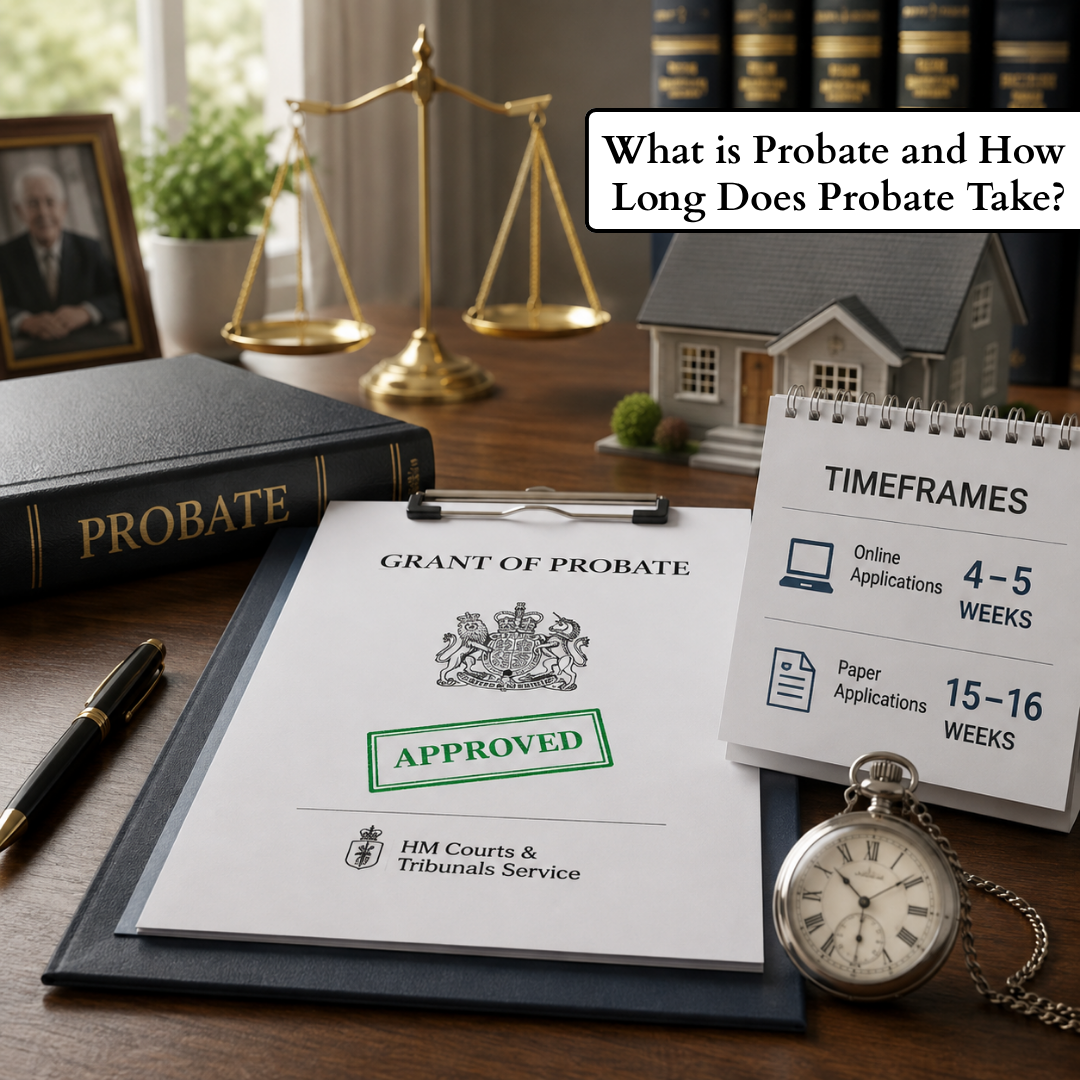
Probate is the legal permission that allows someone to handle a person’s money, property, and belongings after that person dies.
For example, probate may allow you to:
- Access the person’s bank accounts.
- Sell or transfer their house.
- Pay their debts and taxes.
- Distribute their belongings to the people named in their will.
Until probate is granted, you should usually avoid making final financial decisions or selling the person’s property, because you may not yet have the legal authority to do so.
In simple words, probate is official permission to deal with someone’s estate after they die.
How Long Does It Take?
The answer depends on which stage you mean. That's where the confusion starts. Most people use "probate" to mean the whole job of sorting an estate. But in law, probate means one thing: the court's OKAY for the executor to act. That's the grant of probate.
HMCTS told trade bodies like ICAEW in mid-2026 that online cases now take around 4 to 5 weeks on average. That's once HMRC and any tax steps are done. Paper forms are much slower, often 15 to 16 weeks. GOV.UK's own advice is more careful. It says to allow up to 12 weeks from when you apply. That's a fair gap to leave, since the average shifts with demand, and with how tricky each case is.
Ask any executor who's been through it, and they'll say the same thing. The average doesn't matter much. What matters is whether your case gets "stopped" for missing details. That one thing causes more real delay than anything else in the system.
How Long Does the Whole Probate Process Take?
Getting the grant is the middle of the road, not the end of it. Before you can even apply, you often need four to ten weeks. That's just to value the estate and, if tax is due, wait for HMRC to work through it. Once the grant lands, there's still work to do. You need to collect assets, pay off debts, settle any tax owed, and share out what's left.
Add it all up, and a simple estate – no house to sell, no arguments, and a clear will – often takes six to twelve months from death to final payout. A complex estate can take far longer. Think eighteen months to two years if there's a business, assets abroad, or a will under challenge.
How Long Does Probate Take With and Without a Will?
A valid will usually speeds things up. But the real gain is in less preparation time, not a faster court. With a will, the named executor asks for a grant of probate. The court mainly checks that the will is valid and that the person applying has the right to act.
Without a will, different rules step in. This is called intestacy. The closest living relative is often the one who has the right to sort out the estate. They ask for letters of administration instead. This path often takes longer. Not because the court treats it any differently, but because working out who gets what can take real time. Finding the right people to pay isn't always easy, either.
If you are unsure whether your will is valid or properly prepared,
will writing solicitors can help ensure your wishes are clearly documented. This can reduce unnecessary paperwork and make the probate process easier for your loved ones.
What Causes Probate to Be Delayed?
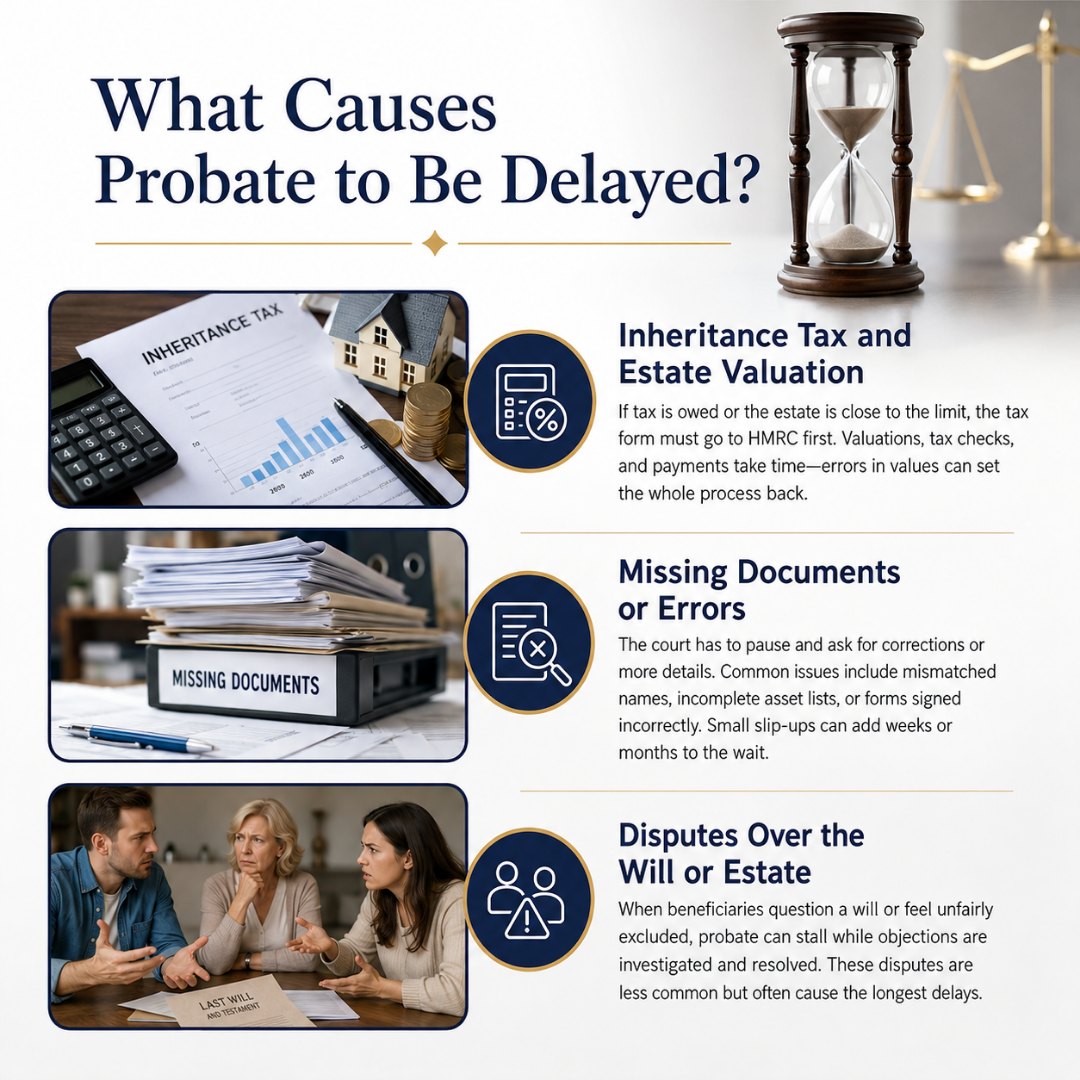
Delays rarely come from one thing alone. Usually it's two or three small obstacles stacking up. Knowing the usual reason makes them easier to avoid.
Inheritance Tax and Estate Valuation
If tax is owed or the estate sits close to the limit, the tax form has to go to HMRC first. Tax needs to be paid, or a plan agreed, before the case can move on. HMRC's own checks add weeks on top of the time it takes to value a house, shares, and other assets. Getting a value wrong is a common trap. It often means sending new numbers later. That sets the whole clock back.
Missing Documents or Errors
This is the big one. A stopped case means the court has to pause and ask for more details. That can add weeks, sometimes months, to the wait. Common causes: names that don't match between the will and the death certificate, a gap in the asset list, or a form signed the wrong way. In our experience, most stops come down to small slip-ups. They're rarely anything truly complex.
Disputes Over the Will or Estate
Sometimes people who stand to inherit don't agree that a will is valid. Sometimes a relative feels left out and isn't happy about it. Either way, probate can stall for months while a formal objection is lodged and sorted out. These cases are less common than paperwork slip-ups. But when they do crop up, they tend to cause the longest waits of all.
If there is uncertainty about the estate or a disagreement between beneficiaries, family solicitors can help clarify the legal position and guide those involved through the next steps. Getting advice early may help prevent small issues from becoming lengthy disputes.
If you’re unsure whether your estate planning documents are robust enough to avoid these common mistakes, our guide
Everything You Need To Know About Will‑Writing Services in the UK walks you through when to use a solicitor, what a good will should cover, and how
professional will-writing can reduce the risk of probate delays
How Does a Solicitor Help With Probate?
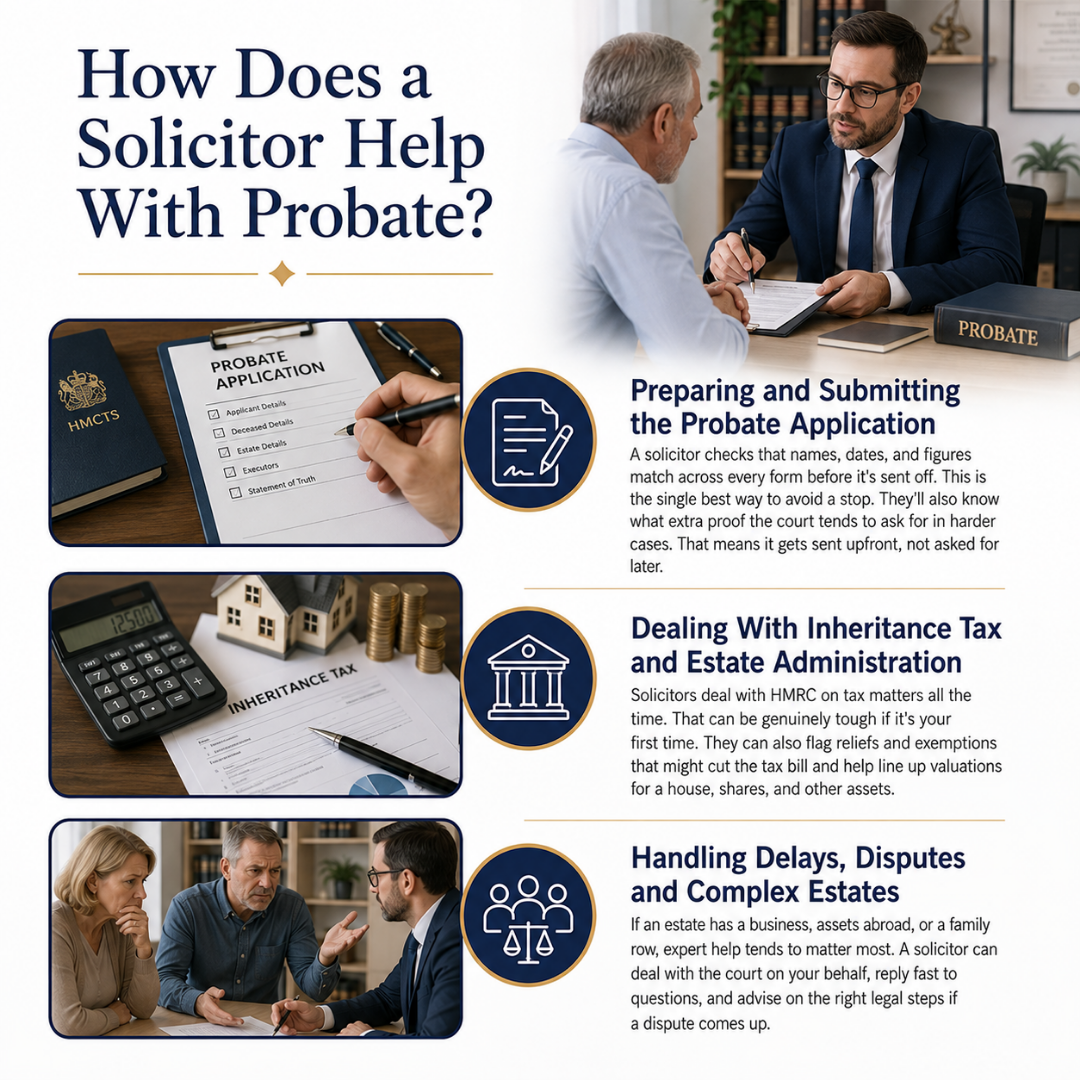
Let's be honest here. No legal solicitor can promise a faster grant. Court timescales work the same, no matter who sends in the case. What a good probate solicitor can do is cut the odds of your case getting stopped. They also handle the parts that trip up first-time executors.
Preparing and Submitting the Probate Application
A solicitor checks that names, dates, and figures match across every form before it's sent off. This is the single best way to avoid a stop. They'll also know what extra proof the court tends to ask for in harder cases. That means it gets sent upfront, not asked for later.
Dealing With Inheritance Tax and Estate Administration
Solicitors deal with HMRC on tax matters all the time. That can be genuinely tough if it's your first time. They can also flag reliefs and exemptions that might cut the tax bill and help line up valuations for a house, shares, and other assets
.
Handling Delays, Disputes and Complex Estates
If an estate has a business, assets abroad, or a family row, expert help tends to matter most. A solicitor can deal with the court on your behalf, reply fast to questions, and advise on the right legal steps if a dispute comes up.
What Happens After Probate Is Granted?
Getting the grant can feel like the finish line. For most executors, though, it's really the start of the next stage.
- Collecting assets: Banks, pension firms, and investment platforms pay out once they see the grant. Some are quicker than others.
- Paying debts and tax bills, funeral costs, and any tax owed need settling before anything gets shared out.
- Sharing out the estate: Once debts are cleared and enough time has passed to allow for any claims, those who inherit get their share.
This stage often takes another three to nine months for a simple estate. It takes longer if a house needs to sell or if assets are hard to turn into cash.
Conclusion
No two estates run the same way. Anyone who promises you an exact date for your grant of probate is just guessing. What helps is knowing the rough shape of the process. Expect a matter of weeks for the grant and months for the full job after that. That way, you can plan around it instead of being caught out. If your estate involves tax, property, or anything out of the ordinary, early advice from a probate solicitor usually pays off. It's often the gap between a smooth few months and a long, drawn-out one.
If you're dealing with probate and want a clearer sense of the timeline for your case, our probate team at
Fosters Legal Solicitor Ltd is happy to talk it through with you.
Frequently Asked Questions
How quickly can probate be granted in the UK?
Probate can sometimes be granted within a few weeks. Recent HMCTS statistics show that probate grants took approximately 5 weeks on average after an application was submitted in early 2026. However, this is not guaranteed. GOV.UK advises that you will usually receive the grant within 12 weeks, and applications can take longer if further information or documents are required
Why is your probate application taking so long?
A probate application can take longer if HMCTS needs further information or identifies an error that prevents the application from progressing. This may involve missing or incorrect information, supporting documents, questions about eligibility or other issues with the application. HMCTS may place the case on a “stop” while the issue is resolved. A stopped application can take significantly longer than one that is complete and correct
Can you speed up the probate process?
Not directly. You can't pay to jump the queue. What you can do is make sure your case is full and correct the first time. Reply fast to any court questions, and sort out tax early if it's owed. This is often where a solicitor makes the biggest real-world gain.
How long does it take to receive money after probate is granted?
It depends on the bank or firm holding the asset. Many pay out within a few weeks of seeing the grant. Bigger or trickier assets, like a house, take longer to turn into cash you can share out.
Does probate take longer if there is no will?
Not necessarily. However, an estate without a will can take longer overall because beneficiaries and the person entitled to administer the estate must be identified. Letters of Administration are usually required instead of a Grant of Probate, and complex family circumstances can cause further delays.