
How Much Do Immigration Solicitors Charge in the UK?
How Much Do Immigration Solicitors Charge in the UK?

Why do solicitor’s fees vary? What am I paying for? What additional costs should I expect? How can I compare quotes? for solicitor assistance with their immigration case would yield ten different answers. This isn't because solicitors are deliberately being vague about their rates – it's because the nature of each case is different, and so is how solicitors choose to charge for their services.
When it comes to choosing a
solicitor for immigration, the cost to you can be a determining factor in your decision, particularly if you are looking to make a spouse visa application, ILR application, or any other form of visa or citizenship application. In the UK, there are two main ways in which immigration solicitors charge for their services, and neither is universally better than the other. This guide breaks down how immigration solicitor fees actually work, what's usually included, and how to tell whether a quote is fair before you sign anything.
What Are Immigration Solicitor Fees?
Simply put, immigration solicitor fees are what you pay to a legal professional for their time and services. It is crucial to understand the difference between solicitor fees and the fees charged by the Home Office.
Solicitor fees cover the representation. The Home Office fees, such as visa application, immigration health surcharge, biometric enrolment, priority processing, etc., these costs are separate from your solicitor's professional fees and may include Home Office application fees, the Immigration Health Surcharge and other associated costs.
When people ask us about what we charge, they often think that the Home Office fees, such as visa application, immigration health surcharge, biometric enrolment, priority processing, etc., are included in the solicitor's bill. They are not. It is a misconception rather than anything else, and so it is best to ask if Home Office fees are included in any quote you are given.
How Can a Solicitor Help You?

Paying for a solicitor's advice means nothing if you have no real idea of the value the professional offers in return. Immigration solicitors can help in more ways than one when dealing with an immigration query. The following are the areas where a solicitor can prove to be of more help:
- Assessing the eligibility criteria to avoid any wasted expenditure and effort in an application that is bound to be refused.
- Identifying any gaps or inconsistencies in supporting evidence before the Home Office spots them.
- Giving guidance on financial support, language competency or any other specific requirements.
- A solicitor can help prepare a complete and well-supported application, but you shouldn't imply that using a solicitor is likely to make the Home Office process the application more quickly.
- Managing all communication with the Home Office on your behalf.
- Advising you on the options open to you if your application is refused or delayed.
- Offering realistic expectations and honest advice about the likely outcome.
They reduce the guesswork – and the risk of a costly mistake.
Knowing the right legal support is important in order to feel confident about your immigration. The
Peterborough solicitors can assist you in finding out the most beneficial option for you before you take any further steps.
How Much Do Immigration Solicitors Charge?
Visa solicitors fees vary a lot from case to case. Straightforward applications usually fall within a set price range, depending on the type of case. Complex cases are typically billed by the hour instead.
Typical Fixed-fee Services Include
- Standard visa applications (work, student, visitor)
- Visa extensions and renewals
- Indefinite Leave to Remain (ILR)
- British citizenship and naturalisation applications
- Family and spouse visa applications
Factors That Can Affect Immigration Solicitor Fees

Several factors can influence how much your immigration solicitor charges, from the complexity of your circumstances to how quickly you need the work done. Things like a previous refusal, financial concerns, or a criminal record can all add to the time and effort involved. Find out more about how a criminal record can affect your case:
Criminal Record
Cases involving a criminal record may require additional legal work and can therefore cost more.
Previous Refusal
A previous visa or immigration application refusal can make the case more complex.
Insufficient Income
Applications involving financial concerns may require additional evidence or legal support.
Urgency
Requesting work within a much shorter timeframe may result in additional fees.
Amount of Documentation
Cases involving extensive paperwork or evidence may take longer to prepare.
Additional Legal Support
Costs may increase if you need help beyond submitting the application, such as preparing for or attending an interview.
Fixed-Fee Immigration Service
Know your immigration costs upfront, with no surprises along the way. See how fixed fees work:
How Fixed Fees Work
A fixed fee works as it sounds – a set price that a client pays the solicitor for a specific piece of work, such as applying for a particular type of visa. The solicitor will establish what is included in the fee, and the client will know ahead of time how much to budget for that particular case.
This option is best suited for people whose circumstances fall within a standard category. It involves less risk for the client, as well as less uncertainty for the solicitor.
Advantages of Fixed Fees
- You know the total cost from day one, which makes household budgeting far easier.
- You have greater certainty over the professional fees covered by the agreed scope of work
- The scope of work is agreed in writing, so both sides know where they stand.
Potential Limitations
As the name suggests, a fixed fee is exactly that – fixed. Additional expenses that fall outside what was agreed upon are the responsibility of the client. This could include costs incurred due to a refused application or additional documentation needed by the Home Office after an application has been submitted.
A
family solicitor may also offer separate options for more involved cases, so it is important to ask whether any additional fees would be incurred if circumstances change
Hourly Rate for an Immigration Solicitor

Charged for the actual time spent on your case, hourly rates can offer more flexibility for complex or unpredictable matters. However, without a cap in place, costs can be harder to predict and may add up if your case takes longer than expected. See how hourly rates work:
How Hourly Rates Work
Unlike a fixed fee, an hourly rate involves the client paying for the time a solicitor spends on their case. This can be measured in increments of six minutes, and the rate will vary depending on the level of experience of the person handling the case – a partner in the firm will charge much more per hour than a trainee or paralegal.
Some
legal solicitors offer this type of billing for cases that require extensive legal research, drafting, and correspondence, such as appeals and judicial reviews, as well as more complex cases that cannot be predicted in advance.
Advantages of Hourly Rates
Hourly billing suits genuinely unpredictable cases. An hourly rate can include any work related to a case, including correspondence with the Home Office as well as legal advice. This type of billing is most common for applications that have additional complexities, such as a criminal record or a previous application refusal. It is also used in situations where the Home Office requires additional information that was not accounted for in the initial application.
Potential Limitations
The most obvious limitation of an hourly rate is that it can be difficult to predict how much a case will cost before engaging a solicitor, as this depends on how much time is spent on the case. This risk can be mitigated by asking for an hourly estimate based on the expected scope of work, and most reputable firms will be transparent about this. However, it is important to remember that unforeseen circumstances on the part of the Home Office or client can push costs higher than expected. An hourly rate is best suited for unpredictable cases where a fixed fee would be inaccurate or fail to account for additional costs.
What Does a Solicitor's Fee Usually Include?
Whether you go with a fixed fee or an hourly rate, the scope of work performed by your immigration lawyers will typically include the following:
- An initial consultation where they will go over the details of your case.
- A review of the necessary documents and evidence required for your application.
- The completion and submission of your application.
- Legal advice specific to your case.
- Correspondence with the Home Office on your behalf.
- Some allowance for follow-up queries after submission.
Always ask what happens after you've sent in your application. Some fixed-fee services stop once the form is submitted, but others may offer ongoing support if the Home Office asks further questions.
Other Immigration Costs to Budget For
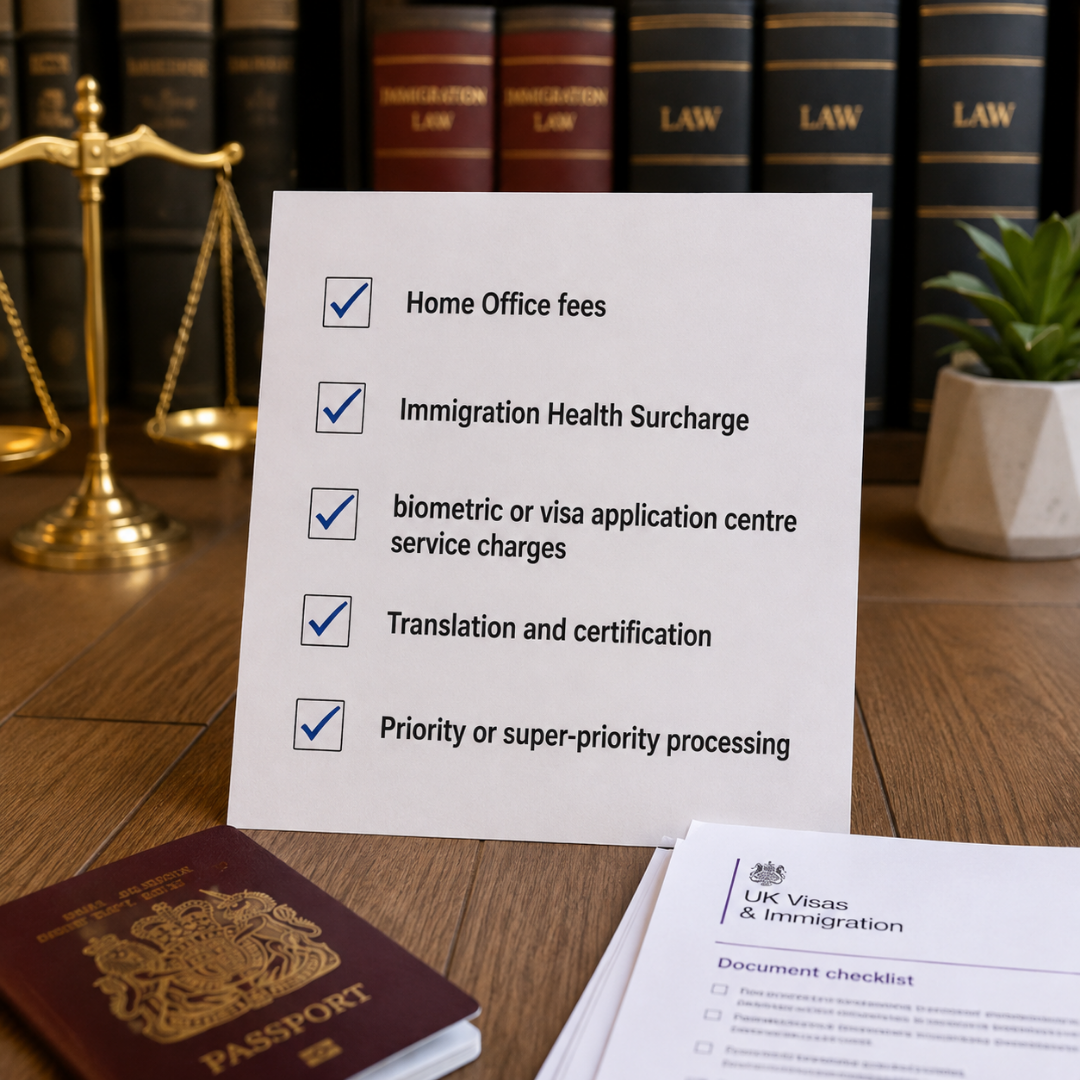
It is important to keep in mind that in addition to your solicitor's fees, you will also need to budget additional funds to pay the Home Office. The exact amount will vary depending on your circumstances, but here are some of the additional fees you may encounter:
- Home Office fees can change, so applicants should check the latest government guidance for the current fee applicable to their immigration route.
- The Immigration Health Surcharge, paid annually for the length of your visa.
- Any applicable biometric or visa application centre service charges.
- Translation and certification of foreign documents.
- Priority or super-priority processing, if you need a faster decision.
If you are applying for a family visa, it is essential to understand the implications on your finances in addition to allocating funds for visa-related legal and application costs. Our “What Are the UK Family Visa Financial Requirements for Overseas Partners?” guide provides details on the income and financial evidence that may be needed for the family visa application.
Questions to Ask About Immigration Solicitor Fee
Does the Fee Cover Calls, Emails, and Follow-up Questions? :-Ask whether the quoted fee includes phone calls, emails, routine follow-up questions, and any additional advice after the initial work.
Is the Fee a Flat Rate or an Hourly Rate? :-Some solicitors charge a fixed (flat) fee, while others bill by the hour or use a combination of both.
Do You Require an Initial Deposit or Retainer Upfront? :-
Some solicitors require an initial deposit or retainer before starting work, while others may not. Always confirm the amount, what it covers, and whether it will be deducted from your final legal bill.
Conclusion
When it comes to choosing between a fixed fee and an hourly rate, it's not a matter of which option is better overall – it's a matter of which one is right for your particular case. A straightforward application generally does not benefit from the uncertainty of an hourly rate, whereas a complex application will not be predicted accurately by a fixed fee. It is important to get a written estimate so you know exactly what you are paying for and to ask about potential additional expenses that may arise. By understanding the difference between a fixed fee and an hourly rate and knowing what to ask, you can avoid many of the pitfalls associated with unexpected charges.
If you would like a detailed, personalised quote for your particular circumstances,
Fosters Legal Solicitors Ltd
can walk you through the details of your case and explain what options you have in terms of payment.
Frequently Asked Questions
How Much Does an Immigration Solicitor Cost in the UK?
The cost of an immigration solicitor varies depending on the complexity of the case, but in general it is possible to get a quote for a fixed fee for a straightforward case or an hourly rate for a more complex one.
Is It Better to Pay a Fixed Fee or Hourly Rate for an Immigration Solicitor?
There is no universal answer to this, as both options have their advantages and disadvantages depending on the circumstances of the case.
Do Immigration Solicitor Fees Include Home Office Fees?
No, a solicitor's fees only cover the services rendered by the solicitor. They do not include Home Office visa application fees, the Immigration Health Surcharge, biometric enrolment, or any other government fees
Can Immigration Solicitors Offer Payment Plans?
Some solicitors do offer payment plans or staged payments for cases with particularly high fees. It is best to enquire directly with the solicitor.
Can You Get Legal Aid for an Immigration Case?
Legal aid is available in some circumstances, but it is much more difficult to obtain for immigration cases than other types of cases. It is best to contact a solicitor and ask if your case is eligible.