How to Find the Right Employment Solicitor in Peterborough for an Unfair Dismissal Claim
How to Find the Right Employment Solicitor in Peterborough for an Unfair Dismissal Claim

If you're thinking about an unfair dismissal claim, you're probably dealing with the shock of losing your job, financial worries and a lot of unanswered questions all at once. That's completely understandable.
Perhaps the meeting lasted ten minutes. Perhaps nobody explained why. Or perhaps you raised a concern a few weeks ago, and now you're out of a job. Losing your income is stressful enough without wondering whether your employer was allowed to do it.
Not every harsh dismissal is unfair in law, but plenty are. And the rules are shifting, so the date on your dismissal letter matters more than ever. This guide explains your rights, the evidence to gather, what a tribunal looks at and what compensation might be possible. It also shows how to choose an
employment solicitor in Peterborough you can trust. It is general guidance, not advice on your own case.
What Is Unfair Dismissal in the UK?
'Unfair dismissal' means your employer ended your job without a fair reason, or without following a fair process. Both matter. Even a good reason can lead to an unfair dismissal if the employer handled it badly.
The law recognises five potentially fair reasons:
- Conduct: misconduct, such as theft or serious rule-breaking.
- Capability: you can't do the job to the required standard, or ill health affects your ability to do it.
- Redundancy: the role is genuinely no longer needed.
- Statutory restriction: keeping you on would break the law, for example, if you lose a required licence.
- Some other substantial reason: a genuine business reason that doesn't fit the others.
A fair reason is only half the test. The employer must also act reasonably. That usually means investigating properly, telling you what's alleged and letting you respond.
Signs a Dismissal May Be Unfair
These situations often raise questions:
- No proper investigation.
- No clear explanation of the reason.
- No chance to respond, or a decision that looked like it was made in advance.
- Different treatment from colleagues in similar situations.
- A redundancy process with no fair selection or consultation.
Take a warehouse worker accused of repeated lateness. If nobody checked the records, nobody asked for their side, and the decision came the same afternoon, the process itself could be challenged.
Unfair Dismissal and Wrongful Dismissal: What's the Difference?
They sound alike, but they're different claims. Unfair dismissal is about the reason and the fairness of the process. Wrongful dismissal is about breach of contract, most often when an employer doesn't give the notice or notice pay for the contract promised. Sometimes both apply to the same dismissal.
Can You Make an Unfair Dismissal Claim? Your Employment Rights Explained
Whether you can bring a claim depends on four things: whether you're an employee, how long you've worked for your employer, why you were dismissed and when your employment ended. Workers and the self-employed usually have fewer rights, so your status matters too.
How Long Do You Need to Have Worked There?
Your effective date of termination, the day your job actually ended, decides which rule applies:
- Before 1 January 2027: you generally need two years' continuous service for an ordinary claim.
- On or after 1 January 2027: the qualifying period falls to six months.
Many people assume two years is a hard rule for everyone. It isn't, as the next part shows.
The change will also benefit employees who already have at least six months of continuous service when the new rules come into effect. Automatically unfair dismissal protections and discrimination protections continue to have their own rules.
When No Minimum Service Is Needed
Some dismissals are "automatically unfair". You don't need any qualifying service if the real reason relates to, for example:
- Pregnancy, maternity or family-related rights.
- Whistleblowing, meaning reporting wrongdoing.
- Health and safety concerns.
- Trade union membership or activities.
- Asserting a statutory right, such as the right to be paid properly.
The exact protection depends on the facts. Probation doesn't change this either. Being "still on probation" never gives an employer free rein to break the law, and a dismissal linked to discrimination can be challenged from day one too.
Dismissal can sometimes happen alongside other employment issues, including unpaid wages or outstanding salary. If your employer also owes you money, our guide to
recovering unpaid salary explains the legal steps you can take to claim the wages you're entitled to receive.
What to Do If You Think You Were Unfairly Dismissed

Acting quickly and calmly helps. Here's a sensible order.
- Ask for the reasons in writing: A short, polite email asking why you were dismissed gives you a record. Keep every reply.
- Read your contract and dismissal letter: Check your notice period, the disciplinary policy and the reason given. Note anything the employer didn't follow.
- Consider an appeal: Explain your concerns clearly and keep copies. An appeal can help, but it doesn't stop the tribunal clock.
- Contact ACAS about early conciliation: In most cases, you must notify ACAS before making a tribunal claim. It's free, and conciliation can sometimes lead to a settlement. ACAS stays neutral, though. It doesn't act as your solicitor.
- Speak to an employment solicitor in Peterborough: A solicitor can assess your position, spot other possible claims, review your evidence and advise on settlement.
For most unfair dismissal claims, you must notify ACAS within six months less one day of your effective date of termination if your dismissal took place on or after 1 October 2026. For dismissals before that date, the previous three-month-minus-one-day limit generally applies.
Going through an internal appeal or grievance procedure does not extend the deadline. ACAS Early Conciliation can pause the time limit, provided you notify ACAS in time. Calculating the exact deadline can be complicated, so seek advice promptly.
What Evidence Do You Need to Prove Unfair Dismissal?
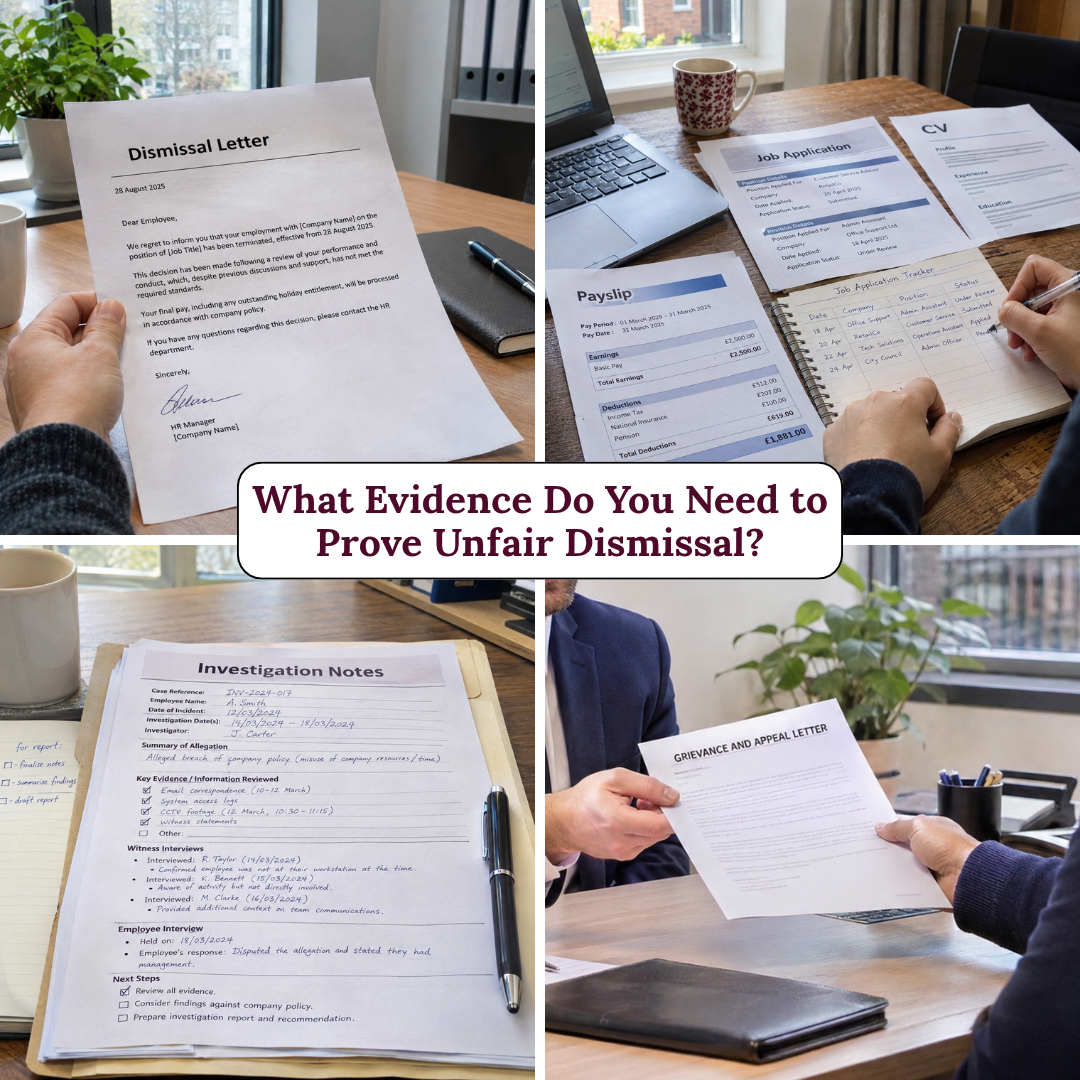
You need records that show what happened, the reason given and whether the employer followed a fair process. The strongest evidence is dated, written and easy to follow.
- Your dismissal letter and employment contract.
- Emails, texts and messages with managers, HR and colleagues.
- Investigation notes, hearing records, warning letters and performance reviews.
- Grievance and appeal letters, plus the employer's replies.
- Names of witnesses who saw or heard relevant events.
- Proof of your financial losses, such as payslips and job applications.
Before you see a solicitor, put everything in date order and write a short timeline. Keep the originals. One word of caution: don't log in to company systems without permission, and don't take documents holding other people's private information. That can create new problems for you.
Evidence can take different forms depending on the circumstances of your case. If your dismissal involved bullying or inappropriate behaviour at work, our guide to workplace harassment evidence explains what may help support your concerns and strengthen your case.
How Do Employment Tribunals Handle Unfair Dismissal Claims?
An employment tribunal is independent. It listens to both sides, weighs the evidence and decides whether the dismissal was fair. It doesn't simply ask whether you were treated badly.
- Early conciliation: ACAS tries to help both sides talk. If that fails, you receive a certificate.
- Your claim: You send the tribunal a claim form (the ET1) setting out what happened. There's no fee to start a claim.
- The employer responds: They file a response (the ET3), usually explaining their reason.
- Preparation: Both sides exchange documents and witness statements.
- The hearing: The tribunal decides whether the employer had a fair reason and acted reasonably.
One point surprises many people. The tribunal usually doesn't swap the employer's judgement for its own. It asks whether dismissal fell within the range of responses a reasonable employer could choose. Many cases settle before a hearing, often through a settlement agreement. Always take advice before signing one.
Compensation for Unfair Dismissal: What Could You Receive?
Compensation is never automatic. You have to win your claim, and the amount depends on your circumstances and your proven losses. Nobody can honestly promise a figure at the start.
A successful claim usually brings two awards:
- Basic award: based on your age, your gross weekly pay (up to a legal limit) and your completed years of service.
- Compensatory award: covers financial losses caused by the dismissal, such as lost earnings and benefits, reasonable expenses and, sometimes, future losses.
If you find a new job, your losses may shrink. You're also expected to look for work and take reasonable steps to limit your loss, which lawyers call mitigation. Keep records of your job search.
The cap is changing too. For dismissals before 1 January 2027, the compensatory award is usually limited to the lower of 52 weeks' pay or a fixed sum. That cap is due to be removed for dismissals on or after 1 January 2027. The basic award limits remain and are updated each April, so check the current figures.
Can you get your job back? Tribunals can order reinstatement (the same job) or re-engagement (a different role), but they rarely do. Compensation is far more common.
How to Choose an Employment Solicitor in Peterborough

By now you'll have a clearer view of your situation. The next question is who to trust with it. A good employment solicitor in Peterborough should make things clearer, not more confusing. Look for:
- Real employment experience: Some best solicitors in Peterborough cover everything from immigration to conveyancing. That's fine, but ask how often they handle dismissal cases like yours, including disciplinary, redundancy, discrimination or whistleblowing issues.
- Tribunal know-how: They should understand ACAS early conciliation, deadlines, evidence and settlement talks.
- An honest case assessment: You want the weak points as well as the strong ones.
- Transparent fees: Ask about the first consultation, fixed fees against hourly rates, estimated total costs and whether legal expenses insurance, often found on home or union policies, could help.
- Easy conversation: You should understand every piece of advice. If it's full of jargon, say so.
- Easy access: A law firm in Peterborough that offers face-to-face and remote meetings can save you time and nerves. A local employment lawyer in Peterborough will also know the area's job market.
Questions worth asking at your first conversation:
- What are the strengths and weaknesses of my claim?
- What evidence do you need from me?
- Is settlement realistic?
- What happens if the case reaches a tribunal?
Why Getting Legal Advice Early Can Make a Difference
Speaking to a solicitor early doesn't commit you to court. It lets you understand your options while the evidence is fresh and the deadlines are still some way off. Early advice can help you check whether you have an unfair dismissal claim, spot other possible claims, preserve evidence and understand a settlement agreement before you sign it. Sometimes a clear letter or a negotiated settlement resolves things without a hearing at all.
Points to Remember
- Not every dismissal is unfair. The reason and the process both matter.
- Your end date sets the qualifying period: two years before 1 January 2027, six months from then.
- Automatically unfair dismissals need no minimum service.
- Keep your letter, contract and messages.
- An appeal doesn't pause the tribunal deadline. ACAS early conciliation can, if you start in time.
- Unfair and wrongful dismissal are different claims.
- Compensation depends on proven losses and is never guaranteed.
- Speak to an employment solicitor before making big decisions.
Speak to an Employment Solicitor in Peterborough About Your Dismissal
Losing your job leaves you with more questions than answers. Was the process fair? Is there a case? What are your options? You don't have to work that out alone.
At Fosters Legal Solicitors, you can talk through your circumstances with a legal professional and explore the options open to you. Whether you're questioning the reason for your dismissal or weighing up an unfair dismissal claim, clear advice helps you take the next step with confidence. No outcome can be promised, but you'll know where you stand.
Get in touch with Fosters Legal Solicitors to discuss your situation.
Frequently Asked Questions
What Counts as Unfair Dismissal in the UK?
A dismissal is unfair when an employer has no fair reason, or acts unreasonably in how it dismisses you. Fair reasons are conduct, capability, redundancy, legal restriction and some other substantial reason. The process must be fair too
How Long Do You Have to Make an Unfair Dismissal Claim?
Usually six months less one day for dismissals on or after 1 October 2026, and three months less one day before that. Contact ACAS within that time. Early conciliation then pauses the clock.
Do You Need Two Years' Service to Claim?
Not always. Two years applies to ordinary claims where employment ends before 1 January 2027. From that date, it's six months. Automatically unfair dismissals need no minimum service.
Can You Claim If You’re Still on Probation?
Possibly. Probation doesn't remove your rights. Automatically unfair dismissal and discrimination protections apply from the start, and ordinary protection applies once you meet the qualifying period.
How Much Compensation Can You Get for Unfair Dismissal?
It depends on your age, service, pay and proven losses. A basic award and a compensatory award are possible. Nothing is guaranteed, and the compensatory cap is due to end for dismissals from 1 January 2027.